Visium
Mouse brain
GSM9517484
silver Interactive viewer H&E traumatic brain injury ✓ Verified publication
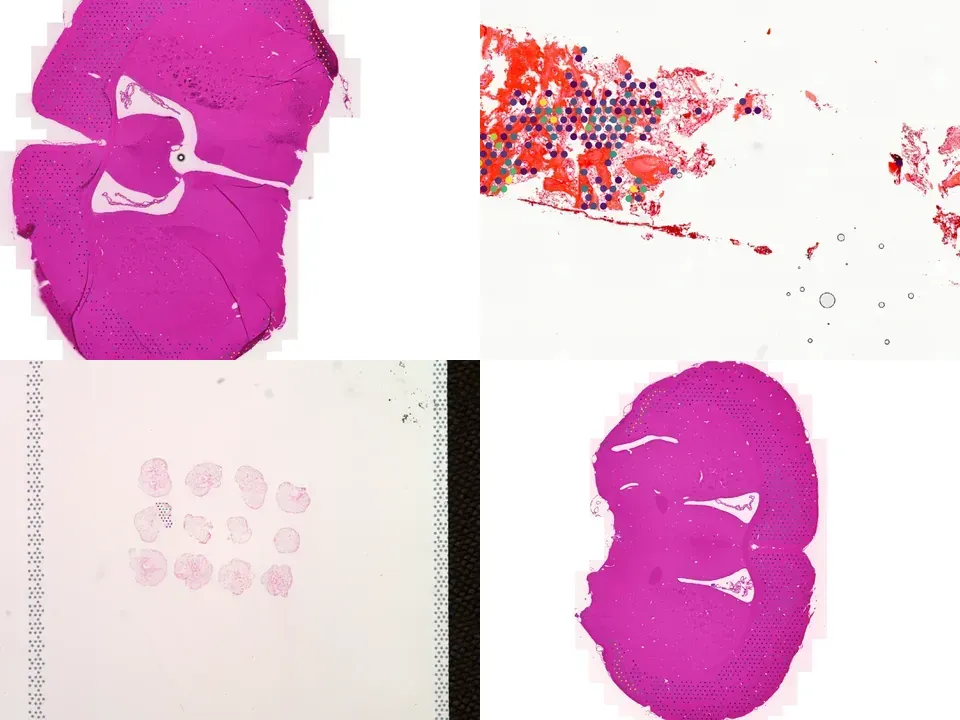
print(sdata)
SpatialData object
├── Images
│     ├── 'GSM9517484_P3-60806_full_image': DataTree[cyx] (3, 3000, 3000), (3, 1500, 1500), (3, 750, 750), (3, 375, 375), (3, 187, 187)
│     ├── 'GSM9517484_P3-60806_hires_image': DataArray[cyx] (3, 2000, 1339)
│     └── 'GSM9517484_P3-60806_lowres_image': DataArray[cyx] (3, 600, 402)
├── Shapes
│     └── 'GSM9517484_P3-60806': GeoDataFrame shape: (3679, 2) (2D shapes)
└── Tables
      └── 'table': AnnData (3679, 19465)
with coordinate systems:
    ▸ 'GSM9517484_P3-60806', with elements:
        GSM9517484_P3-60806_full_image (Images), GSM9517484_P3-60806_hires_image (Images), GSM9517484_P3-60806_lowres_image (Images), GSM9517484_P3-60806 (Shapes)
    ▸ 'GSM9517484_P3-60806_downscaled_hires', with elements:
        GSM9517484_P3-60806_hires_image (Images), GSM9517484_P3-60806 (Shapes)
    ▸ 'GSM9517484_P3-60806_downscaled_lowres', with elements:
GSM9517484_P3-60806_lowres_image (Images), GSM9517484_P3-60806 (Shapes) Python · sddb client
from sddb import Catalog

ds = Catalog().dataset("lIZWVvx4CkeUOkiJ0000")
ds.elements()          # inspect without downloading
sdata = ds.to_sdata()  # cached locally, reused
print(sdata) Python · lamindb
Needs pip install lamindb and network access to the Lamin database, which is limited during the alpha. If it fails, use the Client tab.
import lamindb as ln

db = ln.DB("scverse/spatialdata-db")
artifact = db.Artifact.get("lIZWVvx4CkeUOkiJ")   # stem uid: Lamin resolves it to the latest version

sdata = artifact.load()   # cache, then load into memory
group = artifact.open()   # stream without downloading
path = artifact.cache() # sync into the local cache, returns the path Shell
# sddb client: download the .zarr into data/
sddb-cli download lIZWVvx4CkeUOkiJ0000 --dest data/

# or lamin: cache the dataset and print its local path
lamin load https://lamin.ai/scverse/spatialdata-db/artifact/lIZWVvx4CkeUOkiJ

# or connect once, then load by uid
lamin connect scverse/spatialdata-db
lamin load artifact --uid lIZWVvx4CkeUOkiJLicense: NCBI GEO policy
Part of collection
Mapping the Secondary Response to Traumatic Brain Injury Using Spatial Transcriptomics Shows Acute 4-aminopyridine Treatment Mitigates Axonal and Molecular Pathology→ 24 datasets · comparison
Metadata
- Technology
- Visium
- Organism
- mouse
- Tissue
- brain
- Condition
- traumatic brain injury
- Modality
- RNA
- Observations (spots)
- 3,679
- Tier
- silver
- Chemistry
- Visium CytAssist v2
- Resolution
- 1,339 × 2,000 px
- mpp
- 3.718 µm/px
- Size
- 136 MB
- Sample ID
- GSM9517484
- License
- NCBI GEO policy
- Published
- Feb 12, 2026
Cite this dataset
doi.org/10.1186/s40478-025-02219-1 ↗ BibTeX
@article{Sullivan_2026,
  title = {Mapping the secondary response to traumatic brain injury using spatial transcriptomics shows acute 4-aminopyridine treatment mitigates axonal and molecular pathology},
  volume = {14},
  ISSN = {2051-5960},
  url = {http://dx.doi.org/10.1186/s40478-025-02219-1},
  DOI = {10.1186/s40478-025-02219-1},
  number = {1},
  journal = {Acta Neuropathologica Communications},
  publisher = {Springer Science and Business Media LLC},
  author = {Sullivan, Genevieve M. and Radomski, Kryslaine L. and He, Shaoqiu and Wilkerson, Matthew D. and Dalgard, Clifton L. and Alba, Camille and Zi, Xiaomei and Doughty, Martin L. and Armstrong, Regina C.},
  year = {2026},
  month = Jan
}
Source: NCBI GEO ↗ · License: NCBI GEO policy ↗ · Reprocessed to SpatialData by SpatialData-DB