10x Xenium
Human kidney
GSM8933093
bronze Interactive viewer Provisional
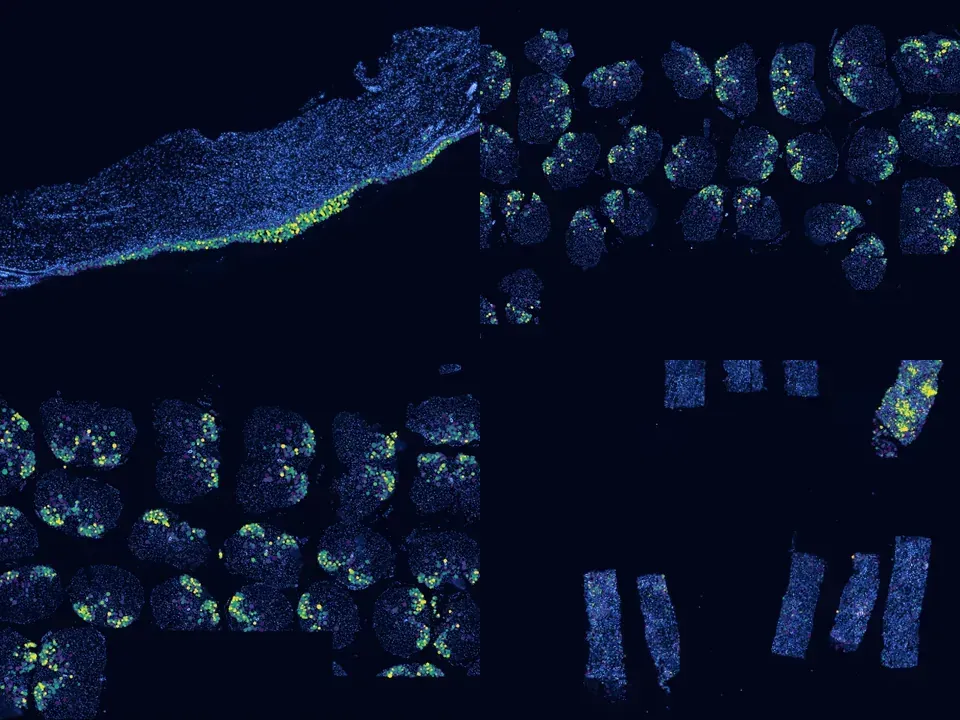
print(sdata)
SpatialData object
├── Images
│     └── 'morphology_mip': DataTree[cyx] (1, 108819, 54194), (1, 54409, 27097), (1, 27204, 13548), (1, 13602, 6774), (1, 6801, 3387)
├── Labels
│     ├── 'cell_labels': DataTree[yx] (106258, 54084), (53129, 27042), (26564, 13521), (13282, 6760), (6641, 3380)
│     └── 'nucleus_labels': DataTree[yx] (106118, 53996), (53059, 26998), (26529, 13499), (13264, 6749), (6632, 3374)
├── Points
│     └── 'transcripts': DataFrame with shape: (20482405, 10) (3D points)
├── Shapes
│     ├── 'cell_boundaries': GeoDataFrame shape: (317414, 1) (2D shapes)
│     ├── 'cell_circles': GeoDataFrame shape: (317414, 2) (2D shapes)
│     └── 'nucleus_boundaries': GeoDataFrame shape: (317414, 2) (2D shapes)
└── Tables
      └── 'table': AnnData (317414, 480)
with coordinate systems:
    ▸ 'global', with elements:
morphology_mip (Images), cell_labels (Labels), nucleus_labels (Labels), transcripts (Points), cell_boundaries (Shapes), cell_circles (Shapes), nucleus_boundaries (Shapes) Python · sddb client
from sddb import Catalog

ds = Catalog().dataset("7Spk0u7nSAkJCybB0000")
ds.elements()          # inspect without downloading
sdata = ds.to_sdata()  # cached locally, reused
print(sdata) Python · lamindb
Needs pip install lamindb and network access to the Lamin database, which is limited during the alpha. If it fails, use the Client tab.
import lamindb as ln

db = ln.DB("scverse/spatialdata-db")
artifact = db.Artifact.get("7Spk0u7nSAkJCybB")   # stem uid: Lamin resolves it to the latest version

sdata = artifact.load()   # cache, then load into memory
group = artifact.open()   # stream without downloading
path = artifact.cache() # sync into the local cache, returns the path Shell
# sddb client: download the .zarr into data/
sddb-cli download 7Spk0u7nSAkJCybB0000 --dest data/

# or lamin: cache the dataset and print its local path
lamin load https://lamin.ai/scverse/spatialdata-db/artifact/7Spk0u7nSAkJCybB

# or connect once, then load by uid
lamin connect scverse/spatialdata-db
lamin load artifact --uid 7Spk0u7nSAkJCybBLicense: NCBI GEO policy
Part of collection
Spatio-temporal interaction of immune and renal cells determines glomerular crescent formation in autoimmune kidney disease→ 9 datasets · publication
Metadata
- Technology
- 10x Xenium
- Organism
- human
- Tissue
- kidney
- Modality
- RNA
- Observations (cells)
- 317,414
- Transcripts
- 20,482,405
- Tier
- bronze
- Size
- 6.0 GB
- Sample ID
- GSM8933093
- License
- NCBI GEO policy
- Published
- May 30, 2025
Cite this dataset
doi.org/10.1038/s41467-025-59819-7 ↗ BibTeX
@article{Wang_2025,
  title = {Type I interferon drives T cell cytotoxicity by upregulation of interferon regulatory factor 7 in autoimmune kidney diseases in mice},
  volume = {16},
  ISSN = {2041-1723},
  url = {http://dx.doi.org/10.1038/s41467-025-59819-7},
  DOI = {10.1038/s41467-025-59819-7},
  number = {1},
  journal = {Nature Communications},
  publisher = {Springer Science and Business Media LLC},
  author = {Wang, Huiying and Engesser, Jonas and Khatri, Robin and Schaub, Darius P. and Paust, Hans-Joachim and Sultana, Zeba and Jauch-Speer, Saskia-Larissa and Peters, Anett and Kaffke, Anna and Bonn, Stefan and Huber, Tobias B. and Mittrücker, Hans-Willi and Krebs, Christian F. and Panzer, Ulf and Asada, Nariaki},
  year = {2025},
  month = May
}
Source: NCBI GEO ↗ · License: NCBI GEO policy ↗ · Reprocessed to SpatialData by SpatialData-DB