
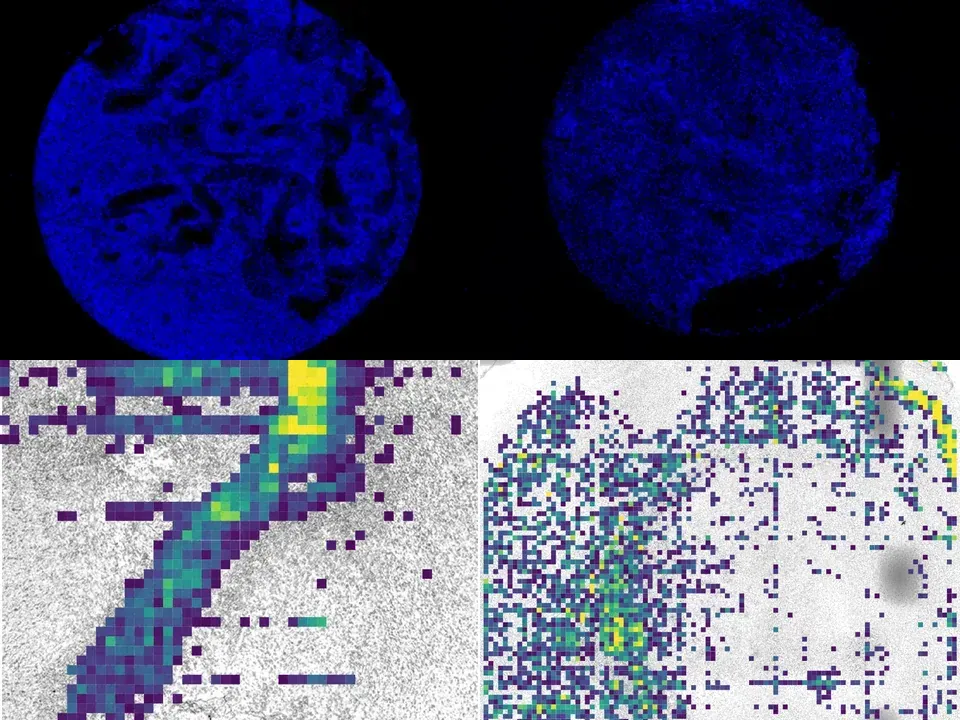
Mouse brain
GSM6753041
mouse brain 16.7 MB 2,498 obs bronze H&E NCBI GEO policy
Technologyspatial ATAC-seq
Organismmouse
Tissuebrain
Obs2,498
bronze H&E NCBI GEO policy
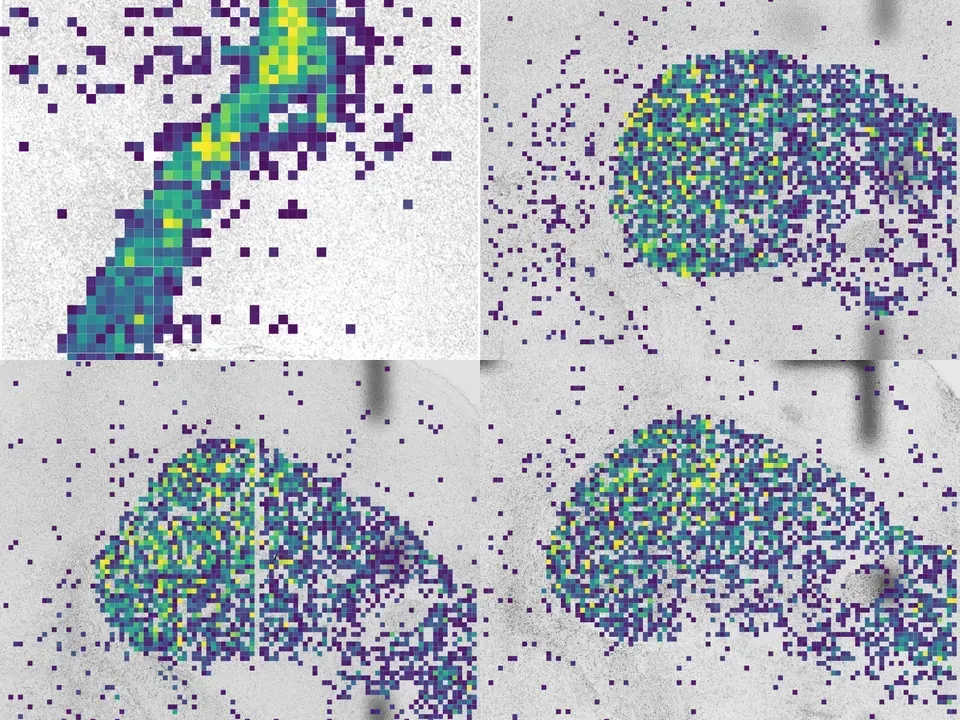
We present spatially resolved high-spatial-resolution genome-wide co-mapping of epigenome and transcriptome by simultaneously profiling of chromatin accessibility and gene expression (spatial-ATAC-RNA-seq), as well as histone modification and gene expression (spatial-CUT&Tag-RNA-seq) on the same tissue section at cellular level by combining the microfluidic deterministic barcoding strategy in DBiT-seq and the chemistry used in ATAC-seq/CUT&Tag.
from sddb import Catalog

cohort = Catalog().collection("geo-gse218593")
cohort.members        # the 6 datasets as a table

print(cohort.licenses())              # check the terms before you download

sdatas = cohort.to_dict()             # {uid: SpatialData}, cached locally
# or keep the .zarr files in a folder of your choice:
# sdatas = cohort.to_dict(dest="data/")Needs pip install lamindb and network access to the Lamin database, which is limited during the alpha. If it fails, use the Client tab.
import lamindb as ln

db = ln.DB("scverse/spatialdata-db")
coll = db.Collection.get(key="geo-gse218593")
coll.ordered_artifacts.to_dataframe()   # the 6 members, ordered

# download every member .zarr to the local cache:
paths = [a.cache() for a in coll.ordered_artifacts.all()]# sddb client: download every member .zarr into data/
sddb-cli download --collection geo-gse218593 --dest data/Licenses: 6 NCBI GEO policy
Emerging spatial technologies, including spatial transcriptomics and spatial epigenomics, are becoming powerful tools for profiling of cellular states in the tissue context<sup>1-5</sup>. However, current methods capture only one layer of omics information at a time, precluding the possibility of examining the mechanistic relationship across the central dogma of molecular biology. Here, we present two technologies for spatially resolved, genome-wide, joint profiling of the epigenome and transcriptome by cosequencing chromatin accessibility and gene expression, or histone modifications (H3K27me3, H3K27ac or H3K4me3) and gene expression on the same tissue section at near-single-cell resolution. These were applied to embryonic and juvenile mouse brain, as well as adult human brain, to map how epigenetic mechanisms control transcriptional phenotype and cell dynamics in tissue. Although highly concordant tissue features were identified by either spatial epigenome or spatial transcriptome we also observed distinct patterns, suggesting their differential roles in defining cell states. Linking epigenome to transcriptome pixel by pixel allows the uncovering of new insights in spatial epigenetic priming, differentiation and gene regulation within the tissue architecture. These technologies are of great interest in life science and biomedical research.
@article{Zhang_2023,
  title = {Spatial epigenome–transcriptome co-profiling of mammalian tissues},
  volume = {616},
  ISSN = {1476-4687},
  url = {http://dx.doi.org/10.1038/s41586-023-05795-1},
  DOI = {10.1038/s41586-023-05795-1},
  number = {7955},
  journal = {Nature},
  publisher = {Springer Science and Business Media LLC},
  author = {Zhang, Di and Deng, Yanxiang and Kukanja, Petra and Agirre, Eneritz and Bartosovic, Marek and Dong, Mingze and Ma, Cong and Ma, Sai and Su, Graham and Bao, Shuozhen and Liu, Yang and Xiao, Yang and Rosoklija, Gorazd B. and Dwork, Andrew J. and Mann, J. John and Leong, Kam W. and Boldrini, Maura and Wang, Liya and Haeussler, Maximilian and Raphael, Benjamin J. and Kluger, Yuval and Castelo-Branco, Gonçalo and Fan, Rong},
  year = {2023},
  month = Mar,
  pages = {113–122}
}