Visium
Human skin of body
GSM9060735
bronze Interactive viewer H&E cutaneous melanoma Provisional
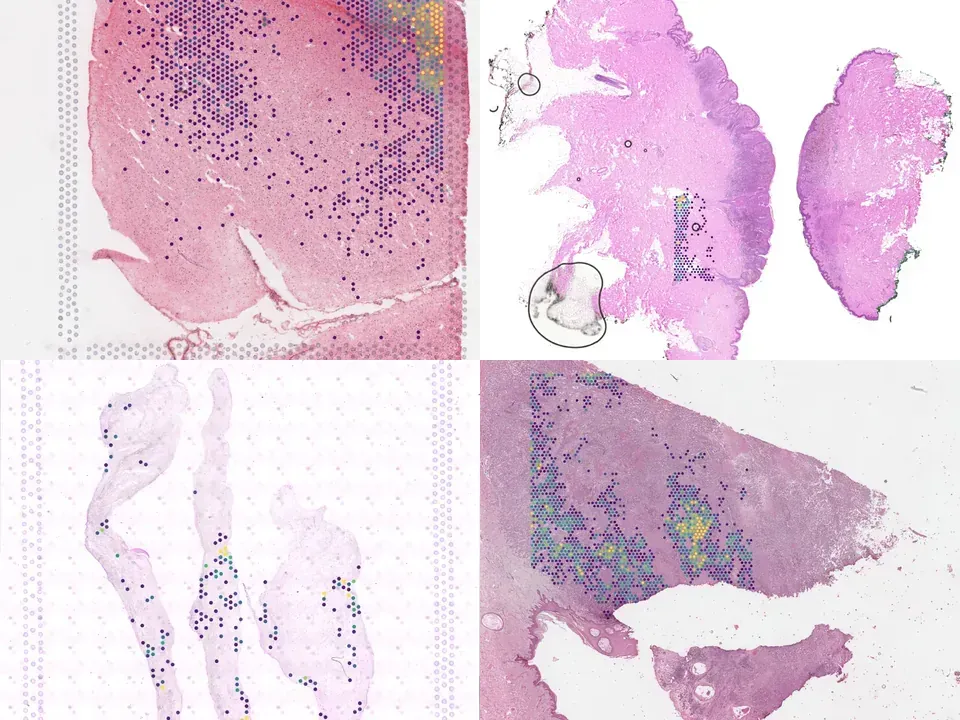
print(sdata)
SpatialData object
├── Images
│     ├── 'GSM9060735_AdjIII-0133_processed_hires_image': DataArray[cyx] (3, 1751, 2000)
│     └── 'GSM9060735_AdjIII-0133_processed_lowres_image': DataArray[cyx] (3, 525, 600)
├── Shapes
│     └── 'GSM9060735_AdjIII-0133_processed': GeoDataFrame shape: (4115, 2) (2D shapes)
└── Tables
      └── 'table': AnnData (4115, 18085)
with coordinate systems:
    ▸ 'GSM9060735_AdjIII-0133_processed', with elements:
        GSM9060735_AdjIII-0133_processed_hires_image (Images), GSM9060735_AdjIII-0133_processed_lowres_image (Images), GSM9060735_AdjIII-0133_processed (Shapes)
    ▸ 'GSM9060735_AdjIII-0133_processed_downscaled_hires', with elements:
        GSM9060735_AdjIII-0133_processed_hires_image (Images), GSM9060735_AdjIII-0133_processed (Shapes)
    ▸ 'GSM9060735_AdjIII-0133_processed_downscaled_lowres', with elements:
GSM9060735_AdjIII-0133_processed_lowres_image (Images), GSM9060735_AdjIII-0133_processed (Shapes) Python · sddb client
from sddb import Catalog

ds = Catalog().dataset("ODtVeb2CpVNHRd1N0000")
ds.elements()          # inspect without downloading
sdata = ds.to_sdata()  # cached locally, reused
print(sdata) Python · lamindb
Needs pip install lamindb and network access to the Lamin database, which is limited during the alpha. If it fails, use the Client tab.
import lamindb as ln

db = ln.DB("scverse/spatialdata-db")
artifact = db.Artifact.get("ODtVeb2CpVNHRd1N")   # stem uid: Lamin resolves it to the latest version

sdata = artifact.load()   # cache, then load into memory
group = artifact.open()   # stream without downloading
path = artifact.cache() # sync into the local cache, returns the path Shell
# sddb client: download the .zarr into data/
sddb-cli download ODtVeb2CpVNHRd1N0000 --dest data/

# or lamin: cache the dataset and print its local path
lamin load https://lamin.ai/scverse/spatialdata-db/artifact/ODtVeb2CpVNHRd1N

# or connect once, then load by uid
lamin connect scverse/spatialdata-db
lamin load artifact --uid ODtVeb2CpVNHRd1NLicense: NCBI GEO policy
Part of collection
Spatial tumour-immune ecosystems shape the efficacy of anti-PD1 immunotherapy in primary cutaneous melanoma [Spatial Transcriptomics]→ 4 datasets · other
Metadata
- Technology
- Visium
- Organism
- human
- Tissue
- skin of body
- Condition
- cutaneous melanoma
- Modality
- RNA
- Observations (spots)
- 4,115
- Tier
- bronze
- Chemistry
- Visium v1
- Resolution
- 2,000 × 1,751 px
- mpp
- 5.124 µm/px
- Size
- 104 MB
- Sample ID
- GSM9060735
- License
- NCBI GEO policy
- Published
- Jun 23, 2026
Cite this dataset
doi.org/10.1136/jitc-2025-014030 ↗ BibTeX
@article{Pham_2026,
  title = {Melanoma cell states shape spatial tumor-immune ecosystems to dictate the efficacy of anti-PD1 immunotherapy},
  volume = {14},
  ISSN = {2051-1426},
  url = {http://dx.doi.org/10.1136/jitc-2025-014030},
  DOI = {10.1136/jitc-2025-014030},
  number = {6},
  journal = {Journal for ImmunoTherapy of Cancer},
  publisher = {BMJ},
  author = {Pham, Félix K and Dufeu, Marion and Benboubker, Valentin and Grimont, Maxime and Lhorisson, Amélie and Berthet, Justine and Donzel, Marie and Schneider, Raphaël and Tonon, Laurie and Doffin, Anne-Claire and Boivin, Félix and Durand, Simon and Dubois, Bertrand and Lopez, Jonathan and Caux, Christophe and Valladeau-Guilemond, Jenny and Eberhardt, Anaïs and Dalle, Stéphane and Caramel, Julie},
  year = {2026},
  month = June,
  pages = {e014030}
}
Source: NCBI GEO ↗ · License: NCBI GEO policy ↗ · Reprocessed to SpatialData by SpatialData-DB