Visium
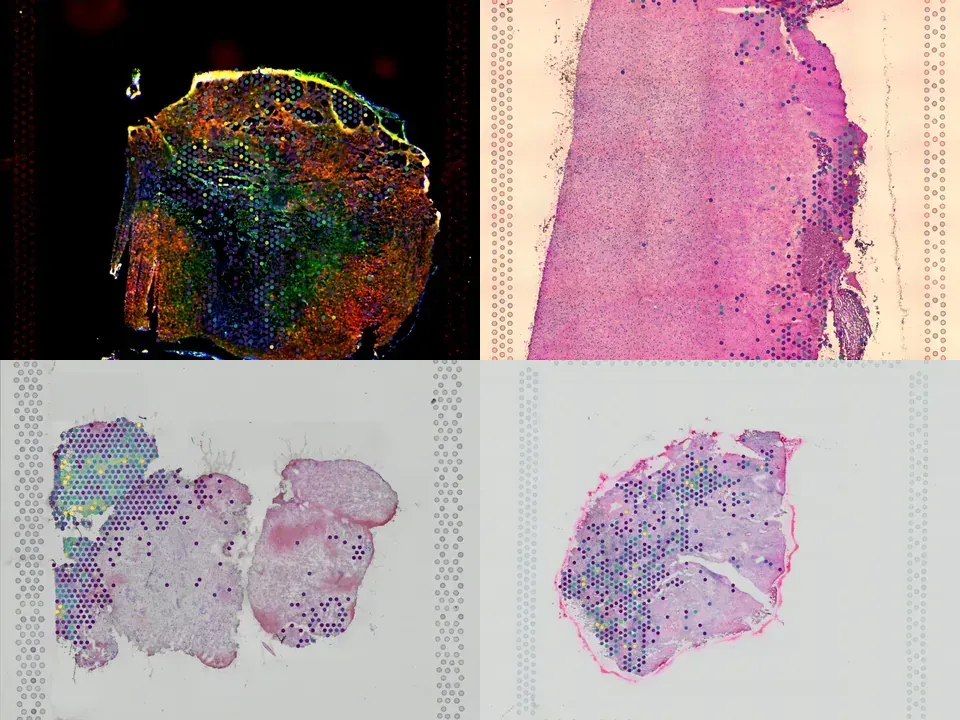
Human breast
GSM7688224
bronze Interactive viewer H&E breast cancer Provisional
print(sdata)
SpatialData object
├── Images
│     ├── 'GSM7688224_Tumor-897_hires_image': DataArray[cyx] (3, 1961, 2000)
│     └── 'GSM7688224_Tumor-897_lowres_image': DataArray[cyx] (3, 589, 600)
├── Shapes
│     └── 'GSM7688224_Tumor-897': GeoDataFrame shape: (2536, 2) (2D shapes)
└── Tables
      └── 'table': AnnData (2536, 36601)
with coordinate systems:
    ▸ 'GSM7688224_Tumor-897', with elements:
        GSM7688224_Tumor-897_hires_image (Images), GSM7688224_Tumor-897_lowres_image (Images), GSM7688224_Tumor-897 (Shapes)
    ▸ 'GSM7688224_Tumor-897_downscaled_hires', with elements:
        GSM7688224_Tumor-897_hires_image (Images), GSM7688224_Tumor-897 (Shapes)
    ▸ 'GSM7688224_Tumor-897_downscaled_lowres', with elements:
GSM7688224_Tumor-897_lowres_image (Images), GSM7688224_Tumor-897 (Shapes) Python · sddb client
from sddb import Catalog

ds = Catalog().dataset("1yTtZCYrcefxMlNm0000")
ds.elements()          # inspect without downloading
sdata = ds.to_sdata()  # cached locally, reused
print(sdata) Python · lamindb
Needs pip install lamindb and network access to the Lamin database, which is limited during the alpha. If it fails, use the Client tab.
import lamindb as ln

db = ln.DB("scverse/spatialdata-db")
artifact = db.Artifact.get("1yTtZCYrcefxMlNm")   # stem uid: Lamin resolves it to the latest version

sdata = artifact.load()   # cache, then load into memory
group = artifact.open()   # stream without downloading
path = artifact.cache() # sync into the local cache, returns the path Shell
# sddb client: download the .zarr into data/
sddb-cli download 1yTtZCYrcefxMlNm0000 --dest data/

# or lamin: cache the dataset and print its local path
lamin load https://lamin.ai/scverse/spatialdata-db/artifact/1yTtZCYrcefxMlNm

# or connect once, then load by uid
lamin connect scverse/spatialdata-db
lamin load artifact --uid 1yTtZCYrcefxMlNmLicense: NCBI GEO policy
Part of collection
Spatial Transcriptomics reveals that cells that experience intratumoral hypoxia retain hypoxia-associated transcriptional programs after invading into oxygenated tumor regions.→ 2 datasets · replicates
Metadata
- Technology
- Visium
- Organism
- human
- Tissue
- breast
- Condition
- breast cancer
- Modality
- RNA
- Observations (spots)
- 2,536
- Tier
- bronze
- Chemistry
- Visium v1
- Resolution
- 2,000 × 1,961 px
- mpp
- 3.415 µm/px
- Size
- 48.5 MB
- Sample ID
- GSM7688224
- License
- NCBI GEO policy
- Published
- Jul 2, 2024
Cite this dataset
doi.org/10.1038/s41467-024-51995-2 ↗ BibTeX
@article{Godet_2024,
  title = {Hypoxia induces ROS-resistant memory upon reoxygenation in vivo promoting metastasis in part via MUC1-C},
  volume = {15},
  ISSN = {2041-1723},
  url = {http://dx.doi.org/10.1038/s41467-024-51995-2},
  DOI = {10.1038/s41467-024-51995-2},
  number = {1},
  journal = {Nature Communications},
  publisher = {Springer Science and Business Media LLC},
  author = {Godet, Inês and Oza, Harsh H. and Shi, Yi and Joe, Natalie S. and Weinstein, Alyssa G. and Johnson, Jeanette and Considine, Michael and Talluri, Swathi and Zhang, Jingyuan and Xu, Reid and Doctorman, Steven and Mbulaiteye, Delma and Stein-O’Brien, Genevieve and Kagohara, Luciane T. and Santa-Maria, Cesar A. and Fertig, Elana J. and Gilkes, Daniele M.},
  year = {2024},
  month = Sept
}
Source: NCBI GEO ↗ · License: NCBI GEO policy ↗ · Reprocessed to SpatialData by SpatialData-DB