
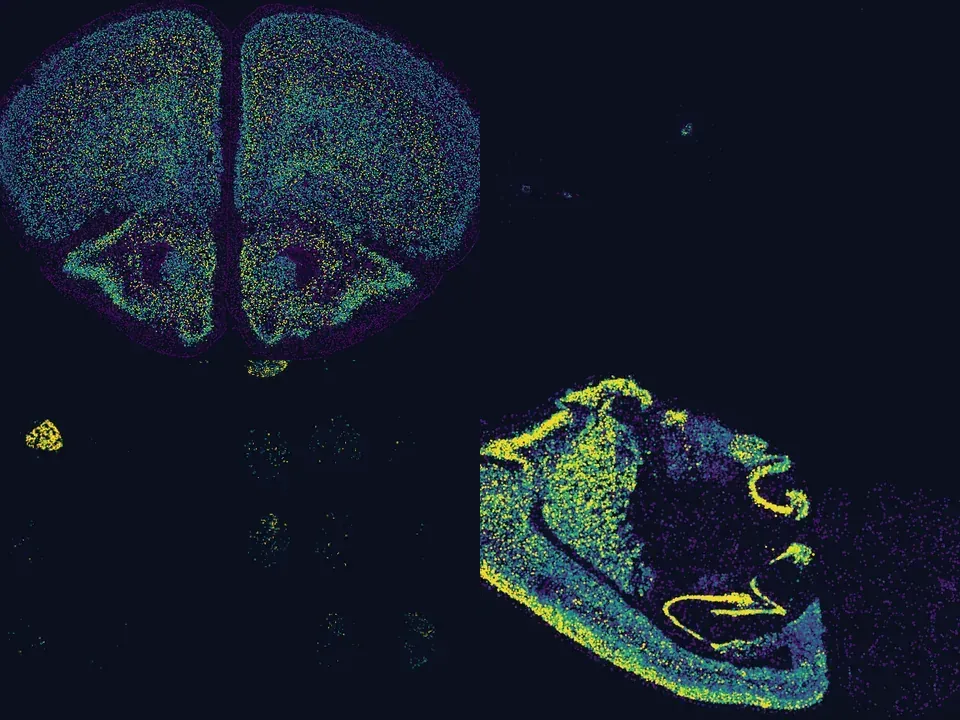
Human unknown
GSM9238730:region_1
human unknown cancer 78.9 MB 86,980 cells bronze NCBI GEO policy
TechnologyVizgen MERSCOPE
Organismhuman
Tissueunknown
Conditioncancer
Cells86,980
bronze NCBI GEO policy
from sddb import Catalog

cohort = Catalog().collection("geo-gsm9238730")
cohort.members        # the 1 datasets as a table

print(cohort.licenses())              # check the terms before you download

sdatas = cohort.to_dict()             # {uid: SpatialData}, cached locally
# or keep the .zarr files in a folder of your choice:
# sdatas = cohort.to_dict(dest="data/")Needs pip install lamindb and network access to the Lamin database, which is limited during the alpha. If it fails, use the Client tab.
import lamindb as ln

db = ln.DB("scverse/spatialdata-db")
coll = db.Collection.get(key="geo-gsm9238730")
coll.ordered_artifacts.to_dataframe()   # the 1 members, ordered

# download every member .zarr to the local cache:
paths = [a.cache() for a in coll.ordered_artifacts.all()]# sddb client: download every member .zarr into data/
sddb-cli download --collection geo-gsm9238730 --dest data/Licenses: 1 NCBI GEO policy
Emerging imaging spatial transcriptomics (iST) platforms and coupled analytical methods can recover cell-to-cell interactions, groups of spatially covarying genes, and gene signatures associated with pathological features, and are thus particularly well-suited for applications in formalin fixed paraffin embedded (FFPE) tissues. Here, we benchmark the performance of three commercial iST platforms-10X Xenium, Vizgen MERSCOPE, and Nanostring CosMx-on serial sections from tissue microarrays (TMAs) containing 17 tumor and 16 normal tissue types for both relative technical and biological performance. On matched genes, we find that Xenium consistently generates higher transcript counts per gene without sacrificing specificity. Xenium and CosMx measure RNA transcripts in concordance with orthogonal single-cell transcriptomics. All three platforms can perform spatially resolved cell typing with varying degrees of sub-clustering capabilities, with Xenium and CosMx finding slightly more clusters than MERSCOPE, albeit with different false discovery rates and cell segmentation error frequencies. Taken together, our analyses provide a comprehensive benchmark to guide the choice of iST method as researchers design studies with precious samples in this rapidly evolving field.
No linked publication found — please cite the data source.