
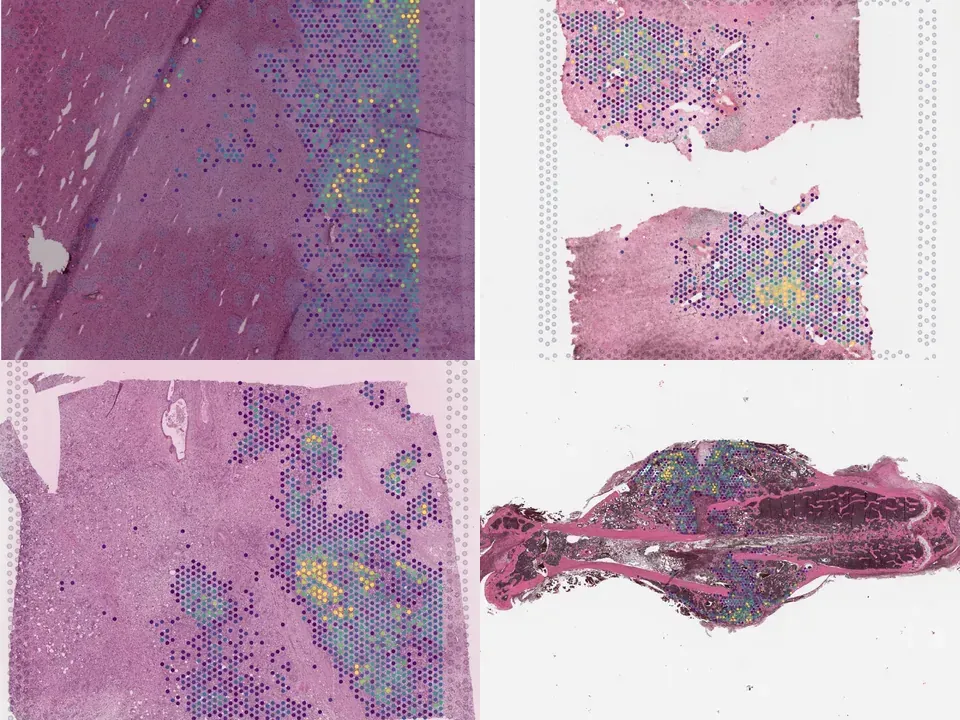
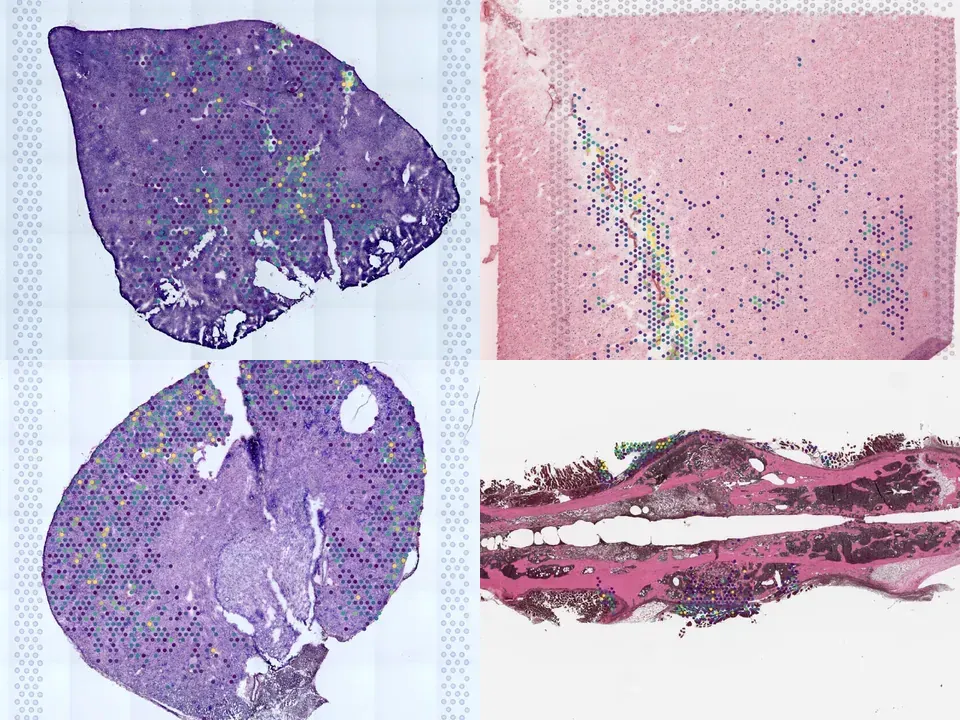
Mouse long bone
GSM9873160
mouse long bone 21.8 MB 3,249 spots bronze H&E NCBI GEO policy
TechnologyVisium
Organismmouse
Tissuelong bone
Spots3,249
Magnificationother · 7.036 µm/px
bronze H&E NCBI GEO policy
Delayed and non-healing fractures, affecting 5–10% of cases, are associated with prolonged disability and diminished quality of life. Although acute inflammation is required to initiate repair, persistent mechanical instability can sustain maladaptive immune and fibrotic responses that impede regeneration. Existing animal models do not adequately recapitulate mechanical instability, the principal driver of hypertrophic nonunion in clinical settings, thereby limiting translational relevance. In this study, we developed a murine model of delayed fracture healing using tunable intramedullary fixation to impose controlled interfragmentary strain. High-strain conditions (low-stiffness nail, 15-30% strain) produced enlarged calluses characterized by delayed ossification, increased fibrotic tissue (2.9-fold, p = 0.0099), and reduced biomechanical integrity (1.6-fold decrease in stiffness, p = 0.024) relative to low-strain controls (high-stiffness nail, <5% strain). Spatial transcriptomic analysis identified persistent fibrotic niches in high-strain calluses enriched with fibroblast-associated genes (e.g., Pdgfrb, Lgals3) and dysregulated macrophage-fibroblast signaling (Spp1, Mmp9). These findings identify mechanical instability as a driver of pathological immune-stromal interactions and establish a preclinical platform for investigating mechanobiology-informed therapeutic strategies. This work supports a conceptual framework in which hypertrophic nonunion is understood as a disorder arising from dysregulated interactions between mechanical cues and immune responses.
from sddb import Catalog

cohort = Catalog().collection("geo-gse338404")
cohort.members        # the 2 datasets as a table

print(cohort.licenses())              # check the terms before you download

sdatas = cohort.to_dict()             # {uid: SpatialData}, cached locally
# or keep the .zarr files in a folder of your choice:
# sdatas = cohort.to_dict(dest="data/")Needs pip install lamindb and network access to the Lamin database, which is limited during the alpha. If it fails, use the Client tab.
import lamindb as ln

db = ln.DB("scverse/spatialdata-db")
coll = db.Collection.get(key="geo-gse338404")
coll.ordered_artifacts.to_dataframe()   # the 2 members, ordered

# download every member .zarr to the local cache:
paths = [a.cache() for a in coll.ordered_artifacts.all()]# sddb client: download every member .zarr into data/
sddb-cli download --collection geo-gse338404 --dest data/Licenses: 2 NCBI GEO policy
@article{Patrick_2026,
  title = {Maladaptive immune-fibrotic axis drives impaired long bone regeneration under mechanical instability},
  volume = {12},
  ISSN = {2375-2548},
  url = {http://dx.doi.org/10.1126/sciadv.adx7511},
  DOI = {10.1126/sciadv.adx7511},
  number = {35},
  journal = {Science Advances},
  publisher = {American Association for the Advancement of Science (AAAS)},
  author = {Patrick, Matthew D. and Ahn, Jaimo and Hankenson, Kurt D. and Annamalai, Ramkumar T.},
  year = {2026},
  month = Aug
}