
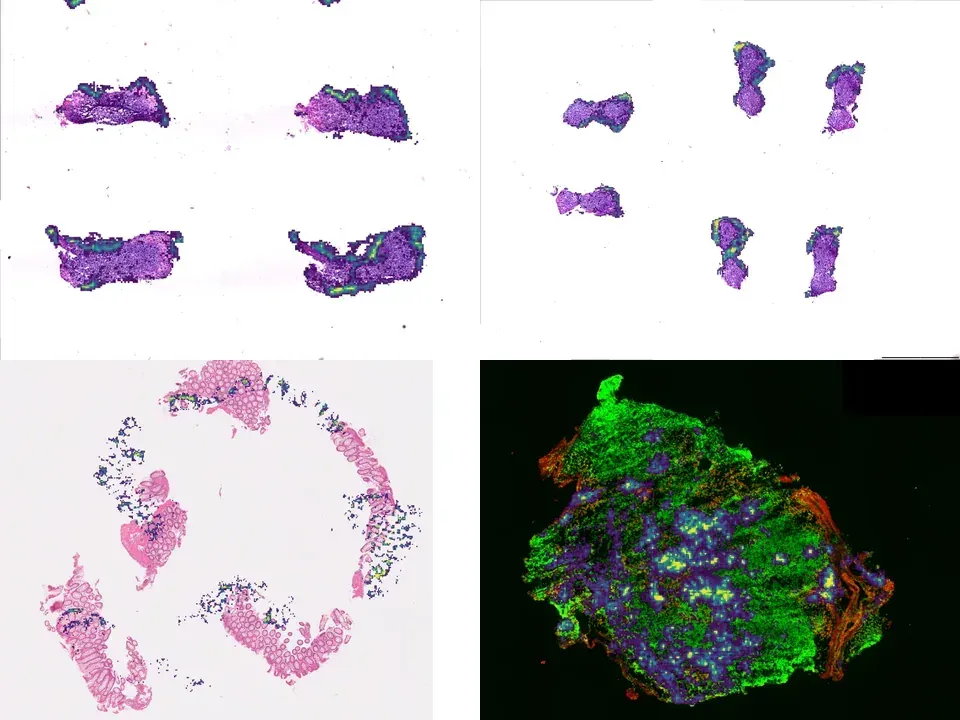
Mouse vestibular ganglion
GSM9269270
mouse vestibular ganglion 725 MB 73,354 bins silver H&E NCBI GEO policy
TechnologyVisium HD
Organismmouse
Tissuevestibular ganglion
Bins73,354
silver H&E NCBI GEO policy
Spatially resolved vestibular ganglion neurons, WT vs Tmie-KO (mouse, Visium HD).
from sddb import Catalog

cohort = Catalog().collection("geo-gse309565-vestibular-ganglion")
cohort.members        # the 2 datasets as a table

print(cohort.licenses())              # check the terms before you download

sdatas = cohort.to_dict()             # {uid: SpatialData}, cached locally
# or keep the .zarr files in a folder of your choice:
# sdatas = cohort.to_dict(dest="data/")Needs pip install lamindb and network access to the Lamin database, which is limited during the alpha. If it fails, use the Client tab.
import lamindb as ln

db = ln.DB("scverse/spatialdata-db")
coll = db.Collection.get(key="geo-gse309565-vestibular-ganglion")
coll.ordered_artifacts.to_dataframe()   # the 2 members, ordered

# download every member .zarr to the local cache:
paths = [a.cache() for a in coll.ordered_artifacts.all()]# sddb client: download every member .zarr into data/
sddb-cli download --collection geo-gse309565-vestibular-ganglion --dest data/Licenses: 2 NCBI GEO policy
Vestibular ganglion neurons (VGNs) are the primary sensory neurons of the vestibular system, a relatively understudied sensory modality that is essential for maintaining visual stability and postural balance. Compared with other sensory systems, our understanding of the molecular heterogeneity of VGNs and its contribution to the diverse functions of the vestibular system remains limited. Using single-cell and spatial transcriptomics, we defined five transcriptionally distinct VGN cell types with discrete spatial distributions across the ganglion. These VGN cell types demonstrate organ-specific innervation patterns, target defined zones within each organ, and form characteristic synaptic endings. To probe their functional roles, we generated genetic tools that selectively label each VGN cell type. Leveraging these tools, we identified a cell type contributing to gravity sensing and otolith-dependent vestibulo-ocular reflexes, revealing a cell type-specific basis for modality-selective vestibular computations.
@article{Liu_2026,
  title = {Morphological and functional diversity of spatially resolved vestibular ganglion neuron cell types},
  volume = {123},
  ISSN = {1091-6490},
  url = {http://dx.doi.org/10.1073/pnas.2530677123},
  DOI = {10.1073/pnas.2530677123},
  number = {28},
  journal = {Proceedings of the National Academy of Sciences},
  publisher = {National Academy of Sciences},
  author = {Liu, Ruiqi and Liu, Jingyue and Chen, Zhiyu and Li, Jingying and Liu, Zhiyong and Sun, Shuohao},
  year = {2026},
  month = July
}