
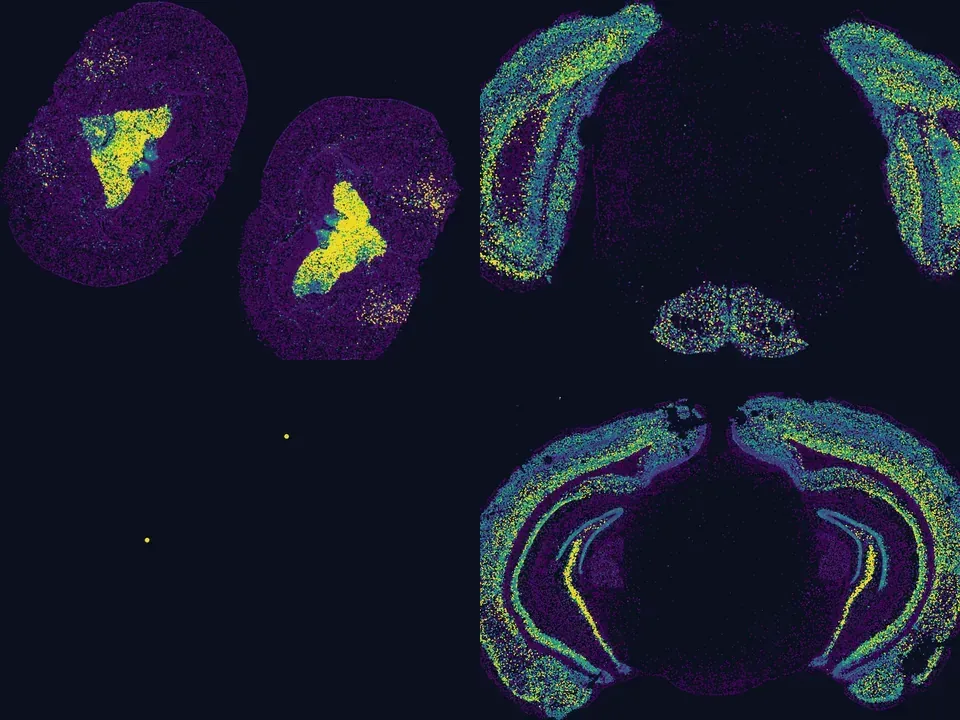
Mouse barrel cortex
GSM9011928
mouse barrel cortex 84.4 MB 239,321 cells bronze NCBI GEO policy
TechnologyVizgen MERSCOPE
Organismmouse
Tissuebarrel cortex
Cells239,321
bronze NCBI GEO policy
from sddb import Catalog

cohort = Catalog().collection("geo-gse298314")
cohort.members        # the 4 datasets as a table

print(cohort.licenses())              # check the terms before you download

sdatas = cohort.to_dict()             # {uid: SpatialData}, cached locally
# or keep the .zarr files in a folder of your choice:
# sdatas = cohort.to_dict(dest="data/")Needs pip install lamindb and network access to the Lamin database, which is limited during the alpha. If it fails, use the Client tab.
import lamindb as ln

db = ln.DB("scverse/spatialdata-db")
coll = db.Collection.get(key="geo-gse298314")
coll.ordered_artifacts.to_dataframe()   # the 4 members, ordered

# download every member .zarr to the local cache:
paths = [a.cache() for a in coll.ordered_artifacts.all()]# sddb client: download every member .zarr into data/
sddb-cli download --collection geo-gse298314 --dest data/Licenses: 4 NCBI GEO policy
Astrocytes and microglia are emerging key regulators of activity-dependent synapse remodeling that engulf and remove synapses in response to changes in neural activity. Yet, the degree to which these cells communicate to coordinate this process remains an open question. Here, we use whisker removal in postnatal mice to induce activity-dependent synapse removal in the barrel cortex. We show that astrocytes do not engulf synapses in this paradigm. Instead, astrocytes reduce contact with synapses prior to microglia-mediated synapse engulfment. We further show that the reduced astrocyte-synapse contact is dependent on the release of Wnts from microglia downstream of neuron-to-microglia fractalkine ligand-receptor (CX3CL1-CX3CR1) signaling. These results demonstrate an activity-dependent mechanism by which microglia instruct astrocyte-synapse interactions, providing a permissive environment for microglia to remove synapses. We further show that this mechanism is critical to remodel synapses in a changing sensory environment and that this signaling is upregulated in several disease contexts.
No linked publication found — please cite the data source.