
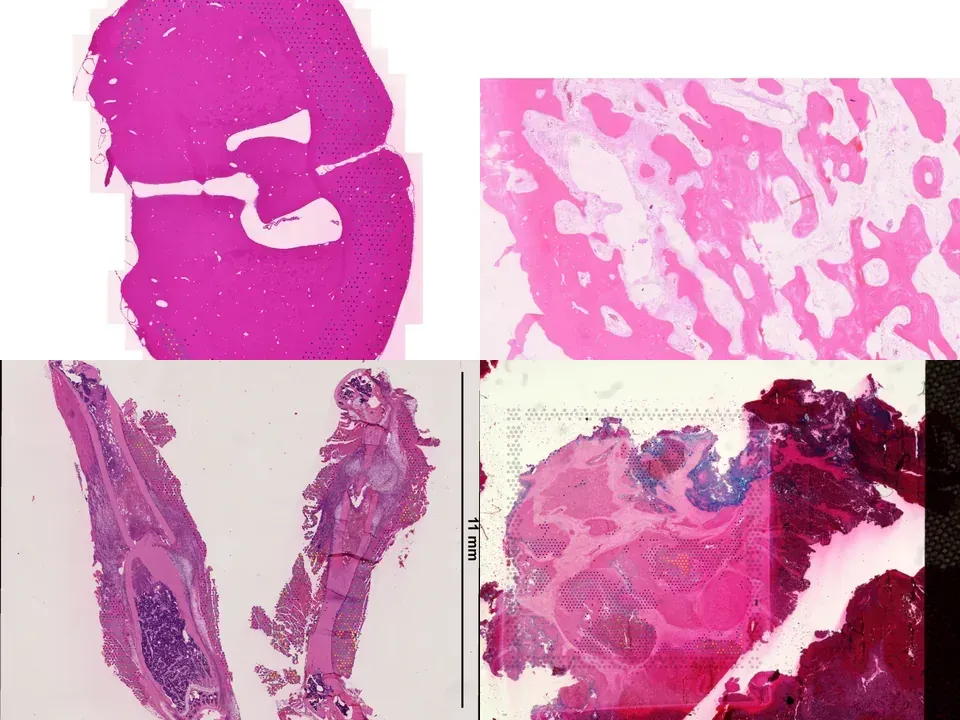
Mouse periosteum
GSM8984116
mouse periosteum bone fracture 152 MB 6,812 spots silver H&E NCBI GEO policy
TechnologyVisium
Organismmouse
Tissueperiosteum
Conditionbone fracture
Spots6,812
silver H&E NCBI GEO policy
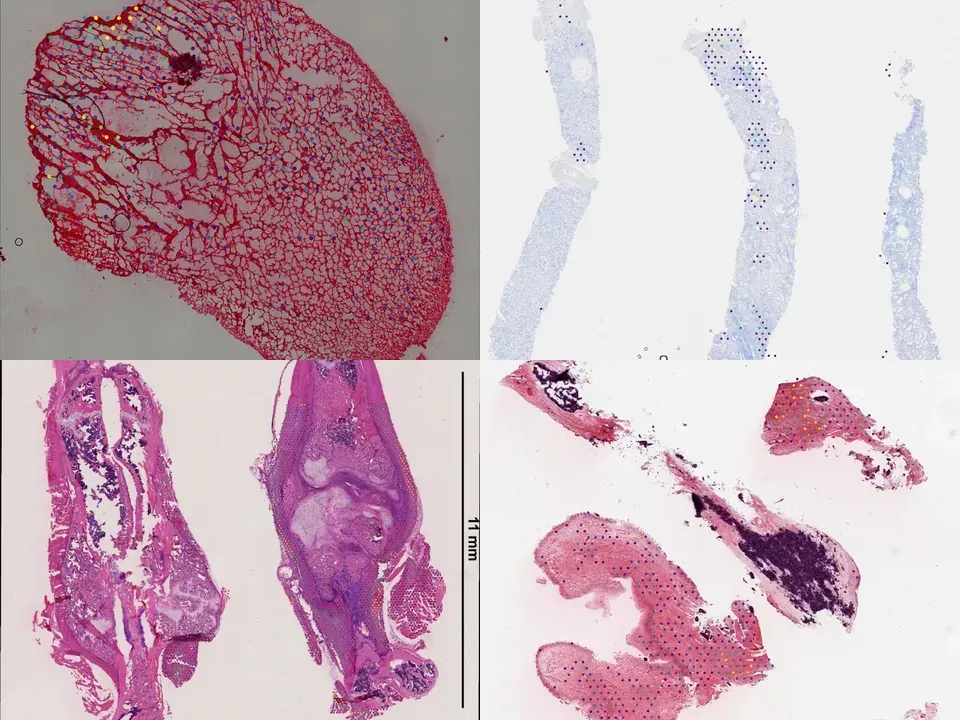
Bone fracture healing is a complex and dynamic processhat requires a detailed understanding of the cellular interactions crucial for successful tissue regeneration. We employs optimized spatial transcriptomics to precisely delineate the locations and interactions of these cells within a mouse femur fracture model at day 0 before fracture and days 5, 15 post-fracture. We improved RNA quality significantly by optimizing our decalcification method using Morse's solution, coupled with the use of the Visium CytAssist platform and integrated analyses through the Seurat, CARD, and Monocle frameworks. This approach allowed us to accurately localize critical cell populations, such as periosteum progenitor cells, and identify pivotal transcription factors that regulate their activation and differentiation into chondrocytes or osteogenic cells. We particularly focused on the transformation from mesenchymal progenitor cells (MPCs) to regenerative MPCs (rMPCs), revealing how these cells recruit macrophages near the fracture line during early healing stages and their involvement in fracture healing. Furthermore, using CellChat, we explored potential receptor-ligand pathways that mediate these cellular interactions. This spatial-temporal mapping and molecular characterization substantially deepen our understanding of the cellular and molecular processes involved in fracture healing, highlighting spatial transcriptomics as a robust approach for elucidating the fundamental mechanisms governing bone regeneration.
from sddb import Catalog

cohort = Catalog().collection("geo-gse297119")
cohort.members        # the 2 datasets as a table

print(cohort.licenses())              # check the terms before you download

sdatas = cohort.to_dict()             # {uid: SpatialData}, cached locally
# or keep the .zarr files in a folder of your choice:
# sdatas = cohort.to_dict(dest="data/")Needs pip install lamindb and network access to the Lamin database, which is limited during the alpha. If it fails, use the Client tab.
import lamindb as ln

db = ln.DB("scverse/spatialdata-db")
coll = db.Collection.get(key="geo-gse297119")
coll.ordered_artifacts.to_dataframe()   # the 2 members, ordered

# download every member .zarr to the local cache:
paths = [a.cache() for a in coll.ordered_artifacts.all()]# sddb client: download every member .zarr into data/
sddb-cli download --collection geo-gse297119 --dest data/Licenses: 2 NCBI GEO policy
@article{Wang_2025,
  title = {Integrating spatial and single-cell transcriptomics to characterize mouse long bone fracture healing process},
  volume = {8},
  ISSN = {2399-3642},
  url = {http://dx.doi.org/10.1038/s42003-025-08316-0},
  DOI = {10.1038/s42003-025-08316-0},
  number = {1},
  journal = {Communications Biology},
  publisher = {Springer Science and Business Media LLC},
  author = {Wang, Hanning and He, Xuan and Ma, Mingjie and Dou, Tianxu and Wei, Yulong and Rux, Danielle and Qin, Ling and Yang, Yan and Zhu, Yue and Yao, Lutian},
  year = {2025},
  month = June
}