
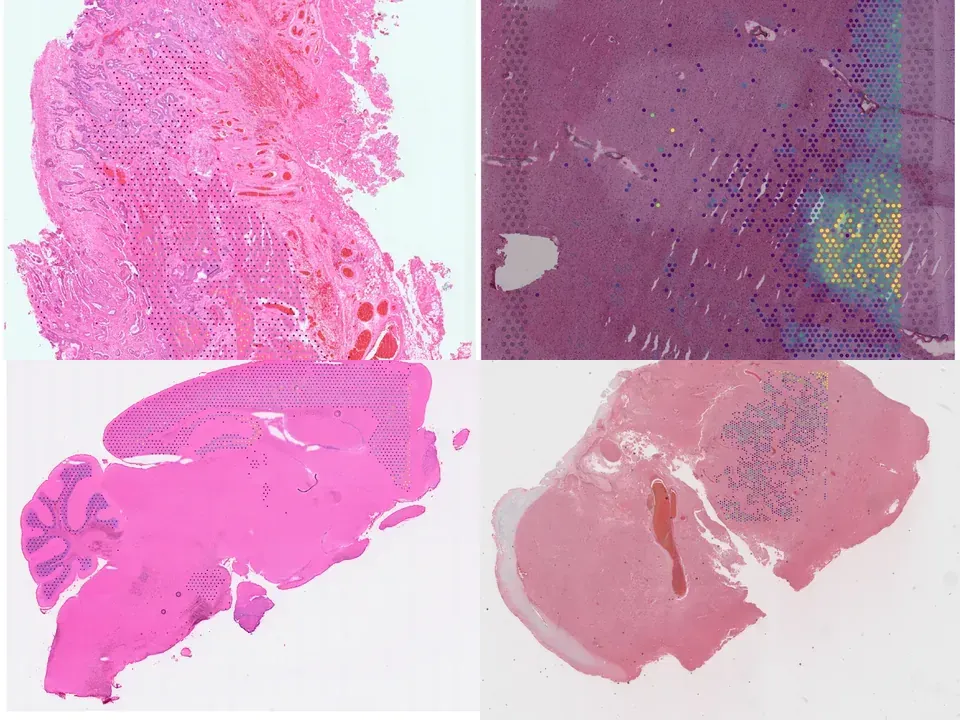
Human brain
GSM8506649
human brain glioblastoma 127 MB 4,501 spots silver H&E NCBI GEO policy
TechnologyVisium
Organismhuman
Tissuebrain
Conditionglioblastoma
Spots4,501
silver H&E NCBI GEO policy
The diversity of transcriptional programs and cellular plasticity of glioma-associated myeloid cells, and thus their contribution to tumor growth and immune evasion, is poorly understood. We performed single cell RNA-sequencing of immune and tumor cells from 33 glioma patients of varying tumor grades. We identified two populations characteristic of myeloid derived suppressor cells (MDSC) that were unique to IDH wild type glioblastomas (GBM) and absent in IDH mutant low-grade gliomas and IDH mutant grade IV astrocytomas: i) an early progenitor population (E-MDSC) characterized by strong upregulation of multiple catabolic, anabolic, oxidative stress, and hypoxia pathways typically observed within tumor cells themselves, and ii) a monocytic MDSC (M-MDSC) population. Spatial transcriptomics demonstrated that the E-MDSCs geographically co-localize with a subset of highly metabolic glioma stem-like tumor cells with a mesenchymal program in the pseudopalisading region, a pathognomonic feature of GBMs associated with poor prognosis. Ligand-receptor interaction analysis revealed symbiotic cross-talk between the stem-like tumor cells and E-MDSCs in GBM, whereby glioma stem cells produce specific chemokines attracting E-MDSCs, which in turn produce growth and survival factors for the tumor cells; in particular the FGFR1 ligand FGF11. This axis is not present in IDH mutant gliomas, associated with hypermethylation and repressed gene expression of the relevant chemokine genes. Our large-scale single-cell analysis elucidated unique MDSC populations that may facilitate GBM progression and mediate tumor immunosuppression.
from sddb import Catalog

cohort = Catalog().collection("geo-gse276841")
cohort.members        # the 2 datasets as a table

print(cohort.licenses())              # check the terms before you download

sdatas = cohort.to_dict()             # {uid: SpatialData}, cached locally
# or keep the .zarr files in a folder of your choice:
# sdatas = cohort.to_dict(dest="data/")Needs pip install lamindb and network access to the Lamin database, which is limited during the alpha. If it fails, use the Client tab.
import lamindb as ln

db = ln.DB("scverse/spatialdata-db")
coll = db.Collection.get(key="geo-gse276841")
coll.ordered_artifacts.to_dataframe()   # the 2 members, ordered

# download every member .zarr to the local cache:
paths = [a.cache() for a in coll.ordered_artifacts.all()]# sddb client: download every member .zarr into data/
sddb-cli download --collection geo-gse276841 --dest data/Licenses: 1 NCBI GEO policy, 1 CC BY 4.0
@article{Jackson_2025,
  title = {Distinct myeloid-derived suppressor cell populations in human glioblastoma},
  volume = {387},
  ISSN = {1095-9203},
  url = {http://dx.doi.org/10.1126/science.abm5214},
  DOI = {10.1126/science.abm5214},
  number = {6731},
  journal = {Science},
  publisher = {American Association for the Advancement of Science (AAAS)},
  author = {Jackson, Christina and Cherry, Christopher and Bom, Sadhana and Dykema, Arbor G. and Wang, Rulin and Thompson, Elizabeth and Zhang, Ming and Li, Runzhe and Ji, Zhicheng and Hou, Wenpin and Zhan, Wentao and Zhang, Hao and Choi, John and Vaghasia, Ajay and Hansen, Landon and Wang, William and Bergsneider, Brandon and Jones, Kate M. and Rodriguez, Fausto and Weingart, Jon and Lucas, Calixto-Hope and Powell, Jonathan and Elisseeff, Jennifer and Yegnasubramanian, Srinivasan and Lim, Michael and Bettegowda, Chetan and Ji, Hongkai and Pardoll, Drew},
  year = {2025},
  month = Jan
}