
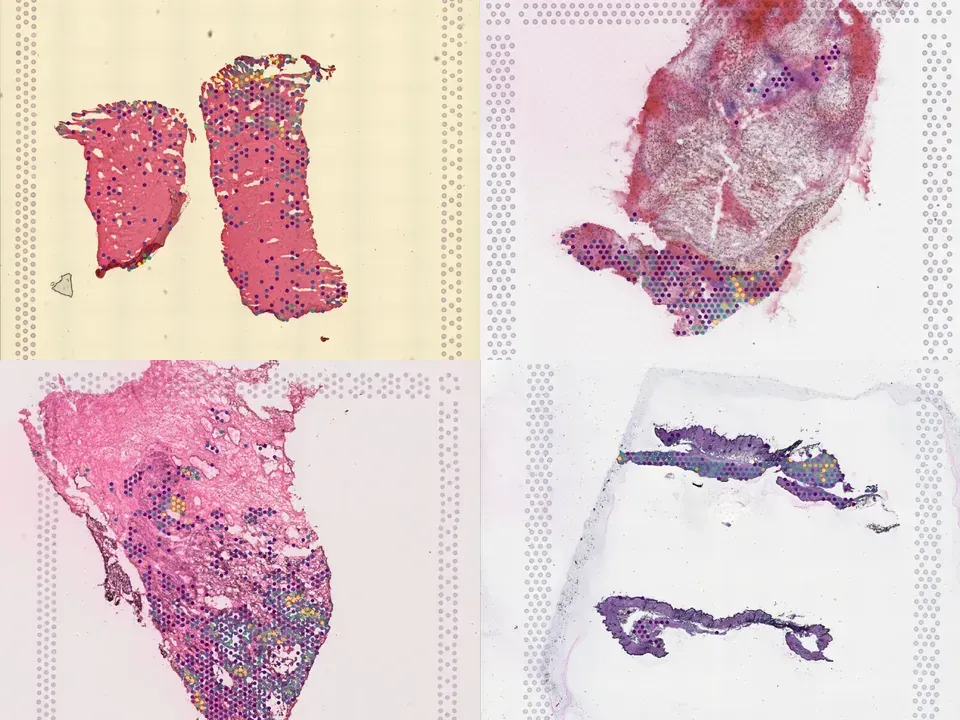
Human brain
GSM8376639
human brain melanoma 13.6 MB 1,732 spots bronze H&E NCBI GEO policy
TechnologyVisium
Organismhuman
Tissuebrain
Conditionmelanoma
Spots1,732
Magnificationother · 4.139 µm/px
bronze H&E NCBI GEO policy
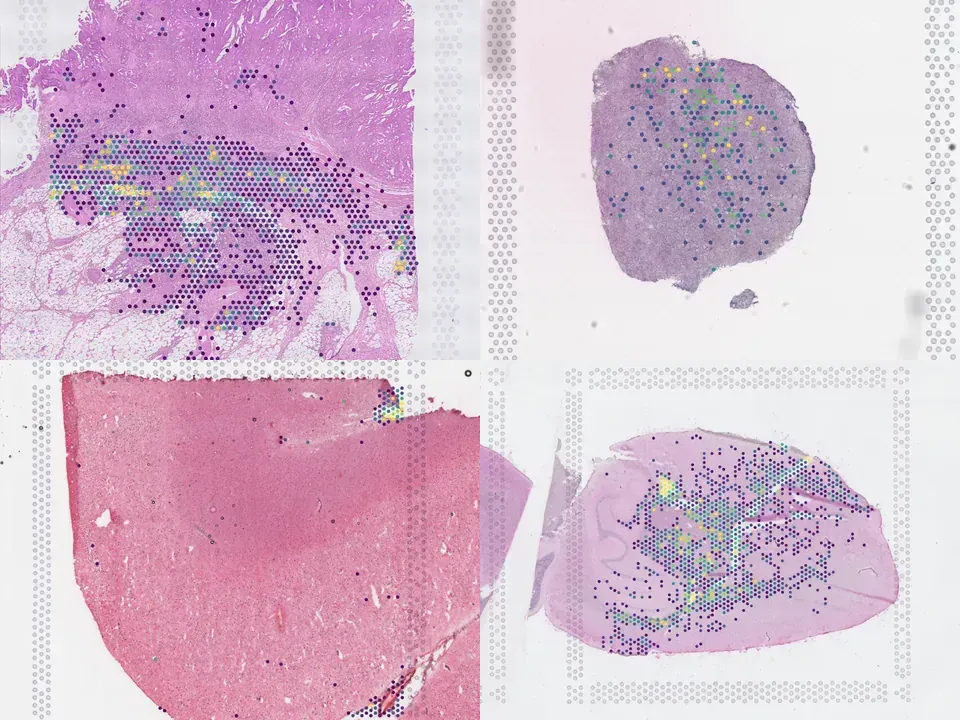
Spatial transcriptomics (ST) is a powerful tool for understanding tissue biology and disease mechanisms. However, the advanced data analysis and programming skills required can hinder researchers from realizing the full potential of ST. To address this, we developed spatialGE, a web application that simplifies the analysis of ST data. The application spatialGE provided a user-friendly interface that guides users without programming expertise through various analysis pipelines, including quality control, normalization, domain detection, phenotyping, and multiple spatial analyses. It also enabled comparative analysis among samples and supported various ST technologies. The utility of spatialGE was demonstrated through its application in studying the tumor microenvironment of two data sets: 10× Visium samples from a cohort of melanoma metastasis and NanoString CosMx fields of vision from a cohort of Merkel cell carcinoma samples. These results support the ability of spatialGE to identify spatial gene expression patterns that provide valuable insights into the tumor microenvironment and highlight its utility in democratizing ST data analysis for the wider scientific community.
from sddb import Catalog

cohort = Catalog().collection("geo-gse271422")
cohort.members        # the 2 datasets as a table

print(cohort.licenses())              # check the terms before you download

sdatas = cohort.to_dict()             # {uid: SpatialData}, cached locally
# or keep the .zarr files in a folder of your choice:
# sdatas = cohort.to_dict(dest="data/")Needs pip install lamindb and network access to the Lamin database, which is limited during the alpha. If it fails, use the Client tab.
import lamindb as ln

db = ln.DB("scverse/spatialdata-db")
coll = db.Collection.get(key="geo-gse271422")
coll.ordered_artifacts.to_dataframe()   # the 2 members, ordered

# download every member .zarr to the local cache:
paths = [a.cache() for a in coll.ordered_artifacts.all()]# sddb client: download every member .zarr into data/
sddb-cli download --collection geo-gse271422 --dest data/Licenses: 2 NCBI GEO policy
@article{Ospina_2024,
  title = {spatialGE Is a User-Friendly Web Application That Facilitates Spatial Transcriptomics Data Analysis},
  volume = {85},
  ISSN = {1538-7445},
  url = {http://dx.doi.org/10.1158/0008-5472.can-24-2346},
  DOI = {10.1158/0008-5472.can-24-2346},
  number = {5},
  journal = {Cancer Research},
  publisher = {American Association for Cancer Research (AACR)},
  author = {Ospina, Oscar E. and Manjarres-Betancur, Roberto and Gonzalez-Calderon, Guillermo and Soupir, Alex C. and Smalley, Inna and Tsai, Kenneth Y. and Markowitz, Joseph and Khaled, Mariam L. and Vallebuona, Ethan and Berglund, Anders E. and Eschrich, Steven A. and Yu, Xiaoqing and Fridley, Brooke L.},
  year = {2024},
  month = Dec,
  pages = {848–858}
}