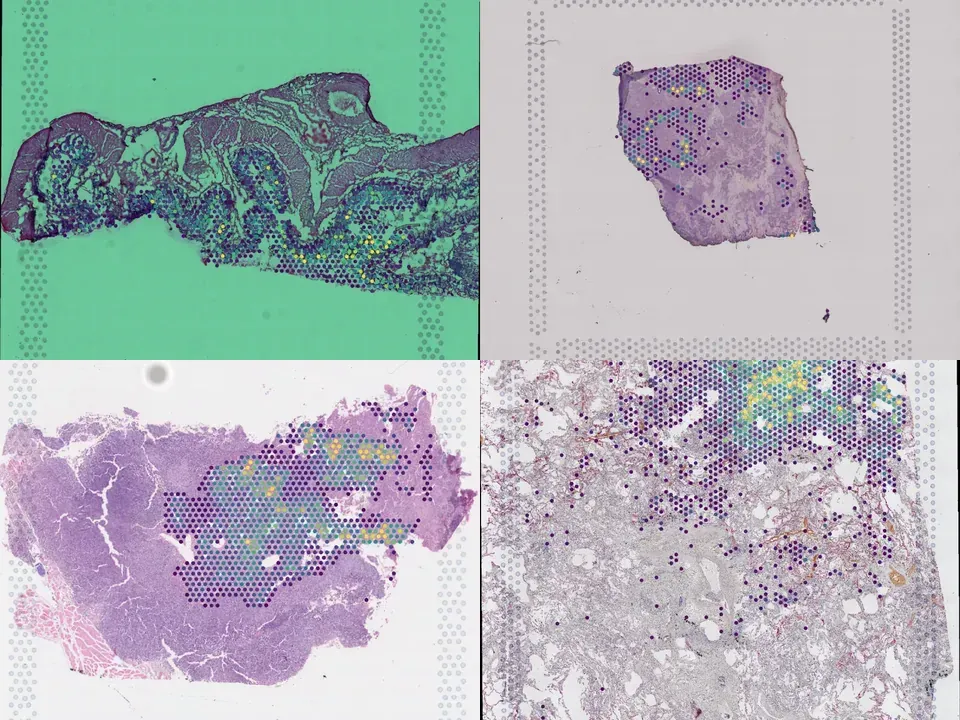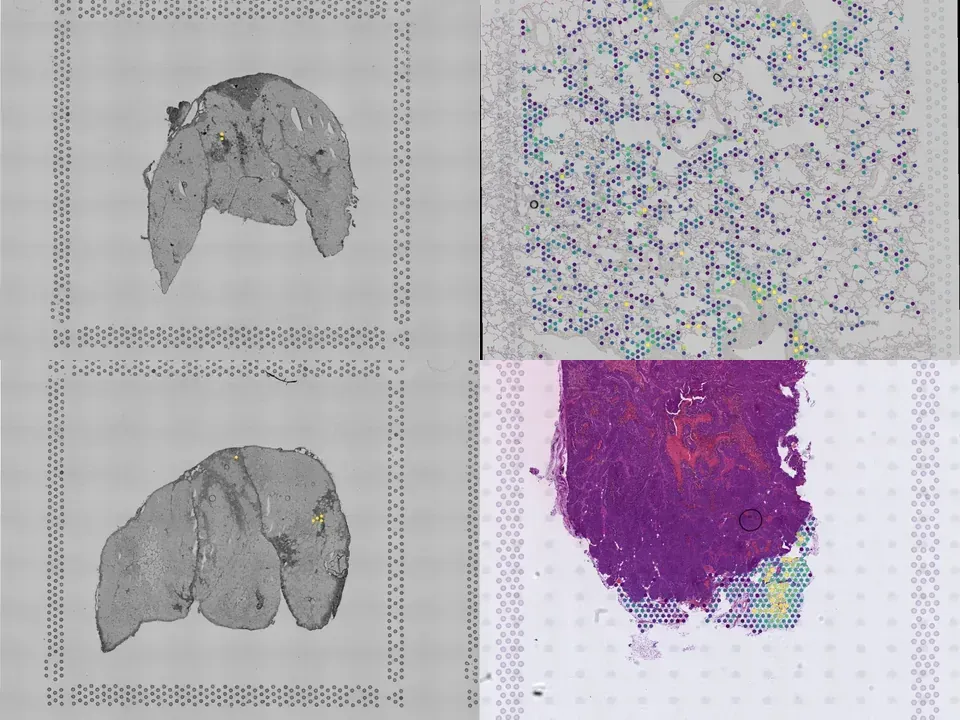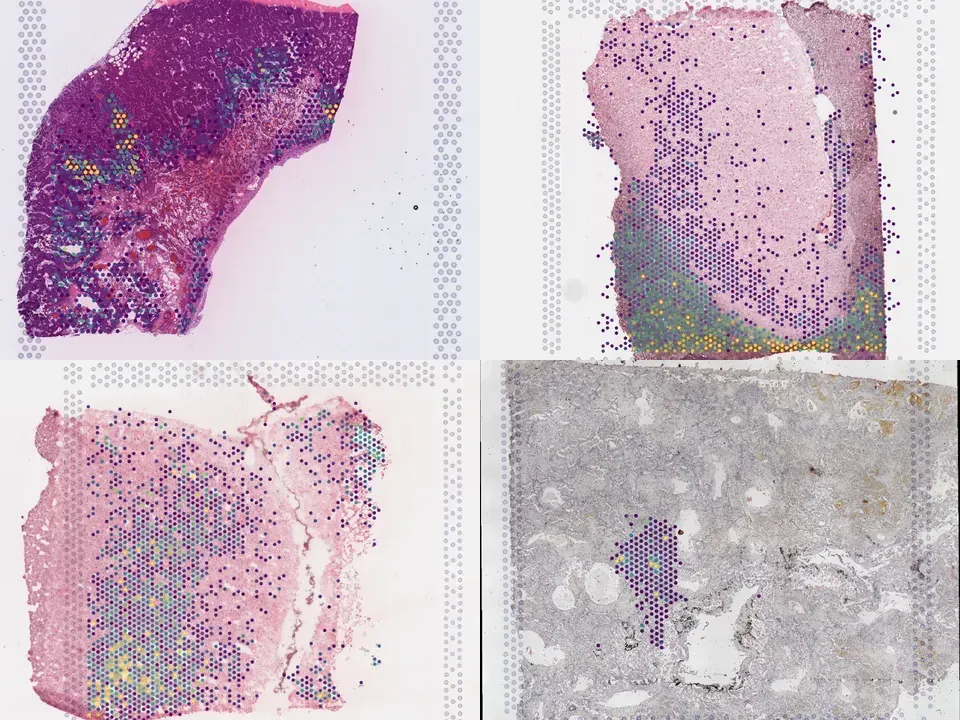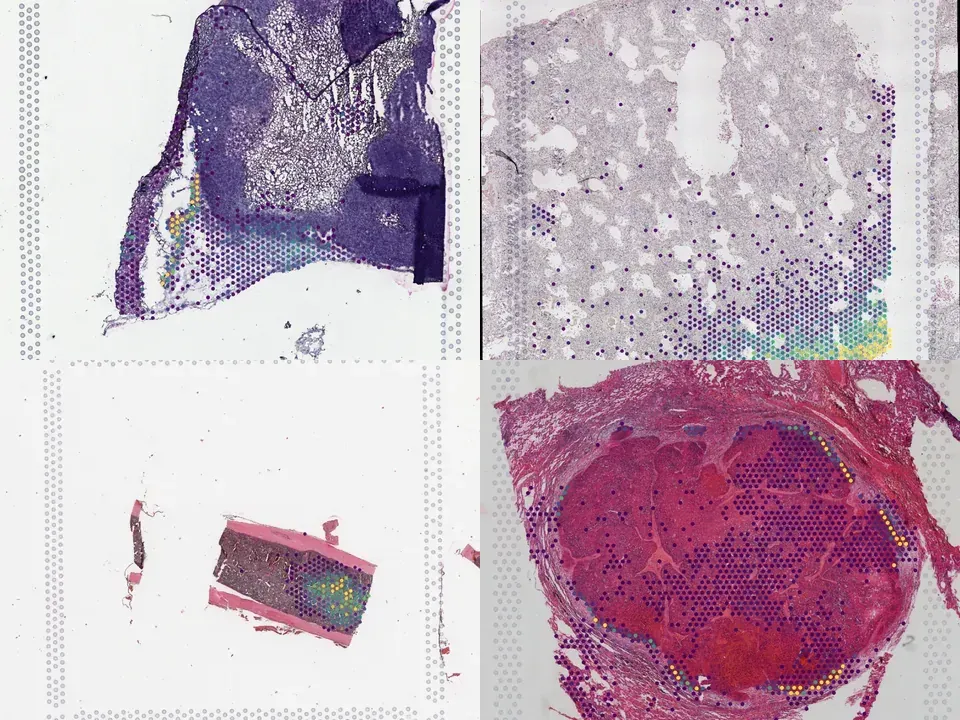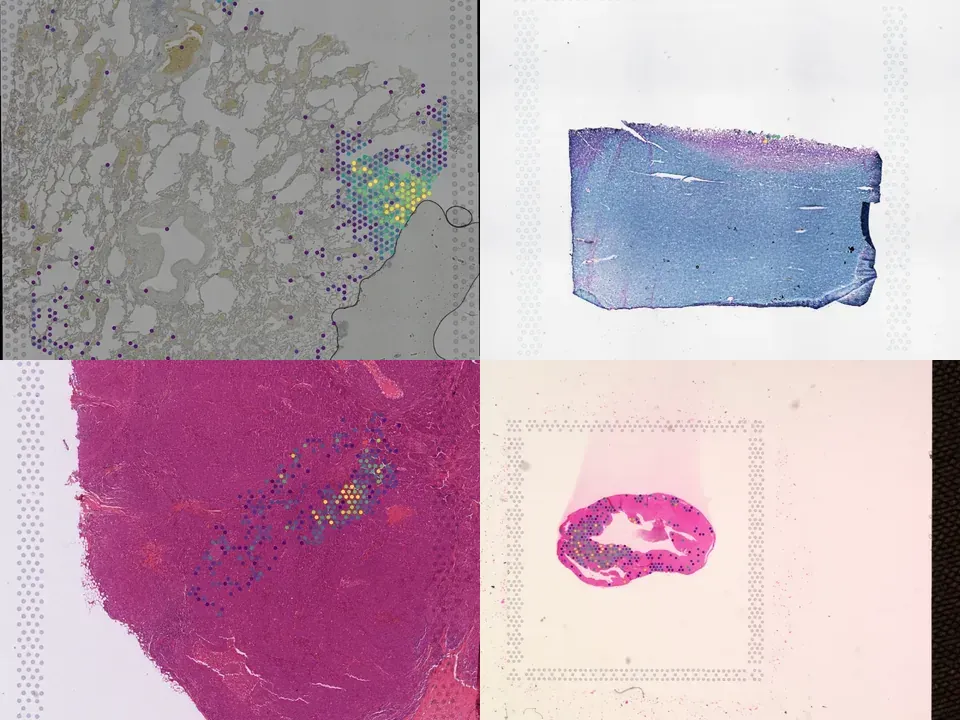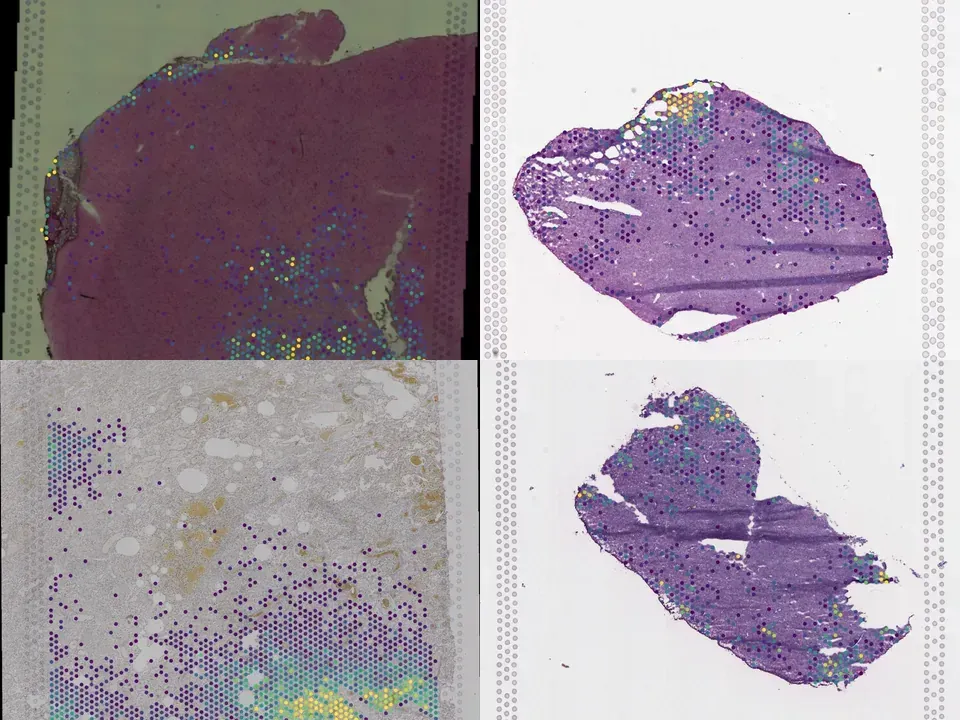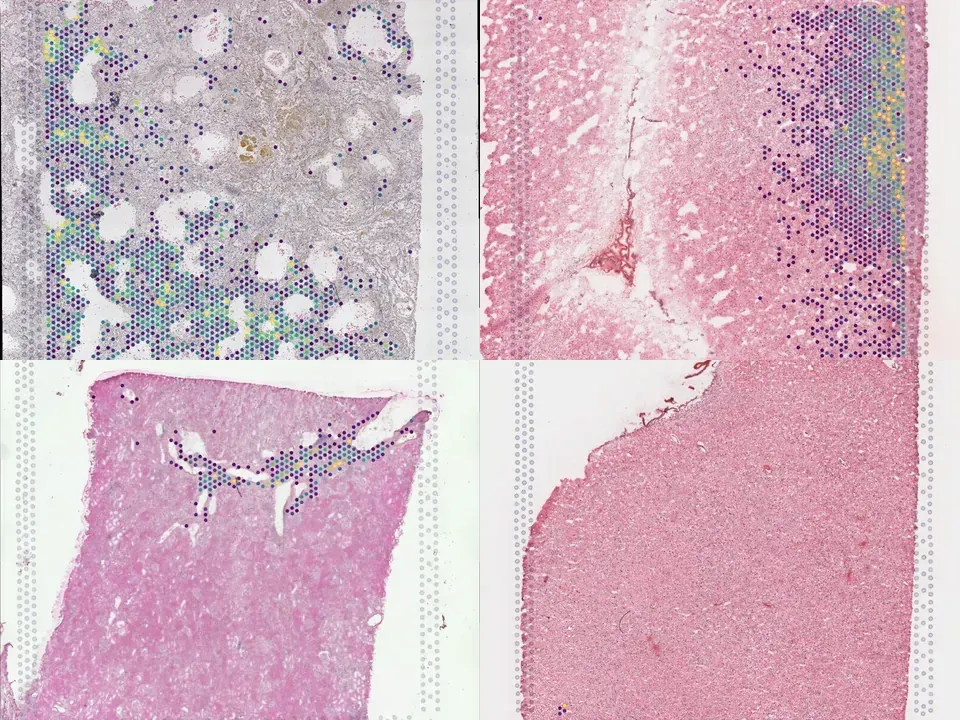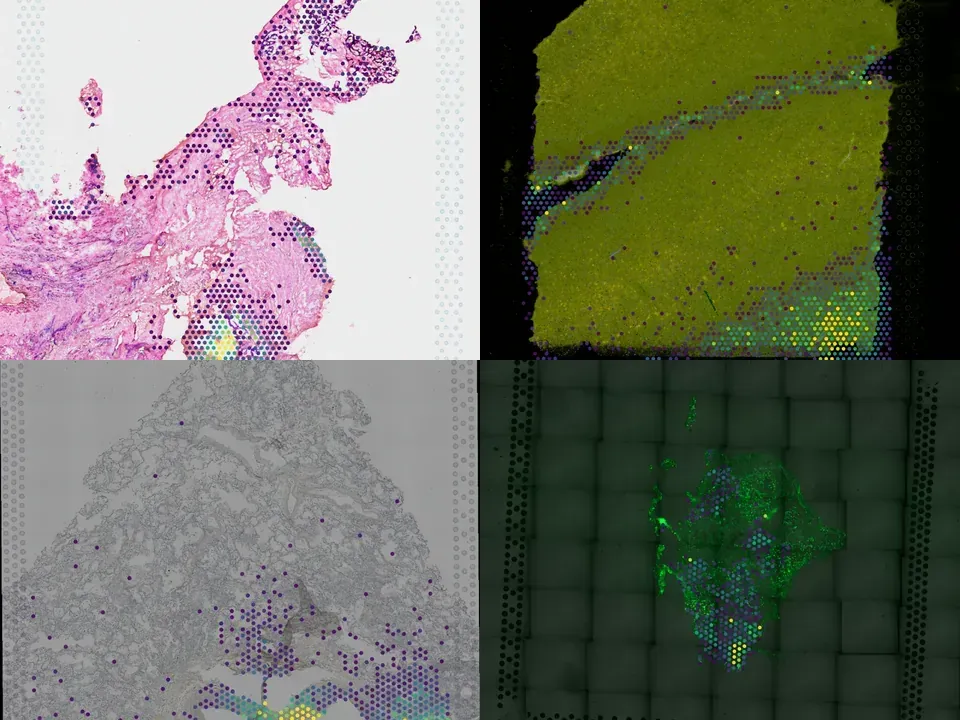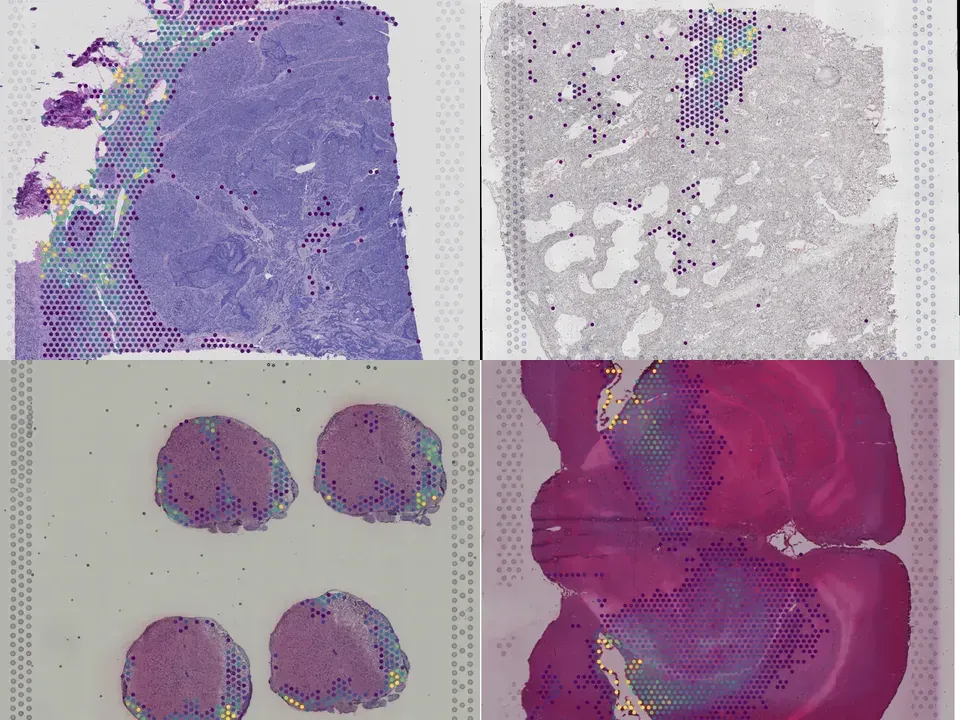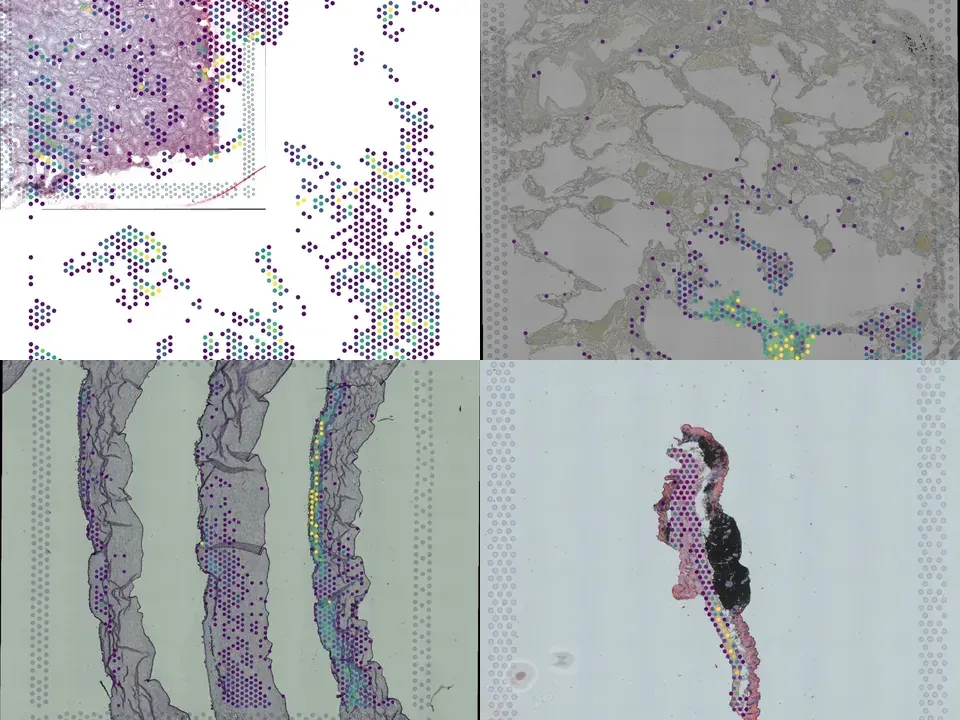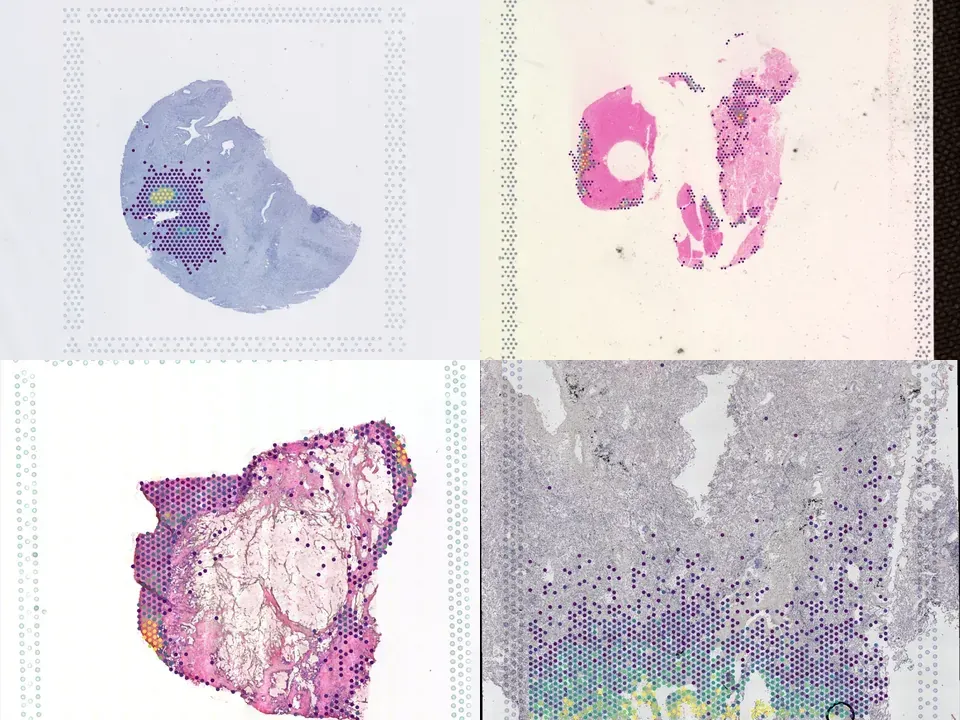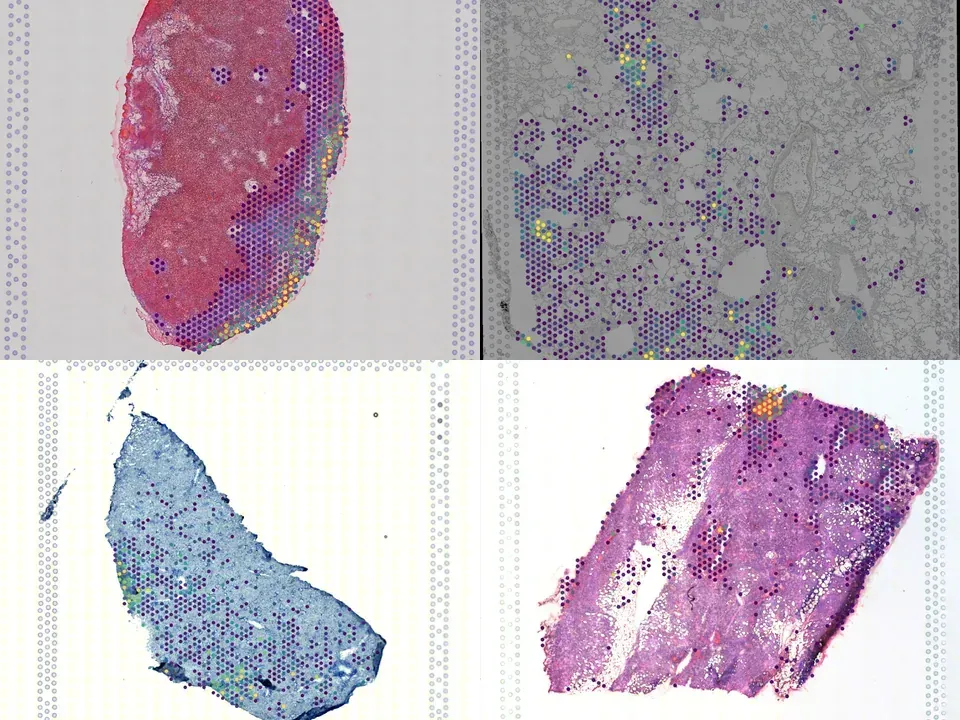
Collections / Spatial transcriptomics unveils the in situ cellular and molecular hallmarks of the lung in fatal COVID-19

Spatial transcriptomics unveils the in situ cellular and molecular hallmarks of the lung in fatal COVID-19

Severe Coronavirus disease 2019 (COVID-19) induces heterogeneous and progressive diffuse alveolar damage (DAD) highly disrupting lung tissue architecture and homeostasis, hampering disease management leading to fatal outcomes. Characterizing DAD pathophysiology across disease progression is of ultimate importance to better understand the molecular and cellular features driving different DAD patterns and to optimize treatment strategies. To contextualize the interplay between cell types and assess their distribution, spatial transcriptomics (ST) techniques have emerged, allowing unprecedented resolution to investigate spatial architecture of tissues. To this end, post-mortem lung tissue provides valuable insights into cellular composition and their spatial relationships at the time of death. Here, we have leveraged VisumST technology in post-mortem COVID-19 induced acute and proliferative DAD lungs including control samples with normal morphological appearance, to unravel the immunopathological mechanisms underlying DAD, providing novel insights into cellular and molecular communication events driving DAD progression in fatal COVID-19. We report a progressive loss of endothelial cell types, pneumocytes type I and natural killer cells coupled with a continuous increase of myeloid and stromal cells, mostly peribronchial fibroblasts, over disease progression. Spatial organization analysis identified variable cellular compartments, ranging from major compartments defined by cell type lineages in control lungs to increased and more specific compartmentalization including immune-specific clusters across DAD spectrum. Importantly, spatially informed ligand-receptor interaction (LRI) analysis revealed an intercellular communication signature defining COVID-19 induced DAD lungs. Transcription factor (TF) activity enrichment analysis identified TGF-B pathway as DAD driver, highlighting SMAD3 and SMAD7 TFs activity role during lung fibrosis. Integration of deregulated LRIs and TFs activity allowed us to propose a downstream intracellular signaling pathway in peribronchial fibroblasts, suggesting potential novel therapeutic targets. Finally, spatio-temporal trajectories analysis provided insights into the alveolar epithelium regeneration program, characterizing markers of pneumocytes type II differentiation towards pneumocytes type I. In conclusion, we provide a spatial characterization of lung tissue architecture upon COVID-19 induced DAD progression, identifying molecular and cellular hallmarks that may help optimize treatment and patient management.

Datasets22
Size~882 MB
AssayVisium
Samplehuman · lung
KindComparison
Flag a data issue
www.ncbi.nlm.nih.gov/geo/query/acc.cgi?acc=GSE271370 ↗
Python · sddb client
from sddb import Catalog

cohort = Catalog().collection("geo-gse271370")
cohort.members        # the 22 datasets as a table

print(cohort.licenses())              # check the terms before you download

sdatas = cohort.to_dict()             # {uid: SpatialData}, cached locally
# or keep the .zarr files in a folder of your choice:
# sdatas = cohort.to_dict(dest="data/")
Python · lamindb

Needs pip install lamindb and network access to the Lamin database, which is limited during the alpha. If it fails, use the Client tab.

import lamindb as ln

db = ln.DB("scverse/spatialdata-db")
coll = db.Collection.get(key="geo-gse271370")
coll.ordered_artifacts.to_dataframe()   # the 22 members, ordered

# download every member .zarr to the local cache:
paths = [a.cache() for a in coll.ordered_artifacts.all()]
Shell
# sddb client: download every member .zarr into data/
sddb-cli download --collection geo-gse271370 --dest data/

Licenses: 22 NCBI GEO policy
Visium
Human lung
GSM8387366
human lung 80.8 MB 4,498 spots silver H&E NCBI GEO policy
TechnologyVisium
Organismhuman
Tissuelung
Size80.8 MB
Spots4,498
silver H&E NCBI GEO policy
Open in Vitessce
Visium
Human lung
GSM8387371
human lung 23.0 MB 4,619 spots silver H&E NCBI GEO policy
TechnologyVisium
Organismhuman
Tissuelung
Size23.0 MB
Spots4,619
silver H&E NCBI GEO policy Open in Vitessce
Open in Vitessce
Visium
Human lung
GSM8387376
human lung 32.4 MB 4,086 spots silver H&E NCBI GEO policy
TechnologyVisium
Organismhuman
Tissuelung
Size32.4 MB
Spots4,086
silver H&E NCBI GEO policy Open in Vitessce
Open in Vitessce
Visium
Human lung
GSM8387365
human lung 70.0 MB 4,212 spots silver H&E NCBI GEO policy
TechnologyVisium
Organismhuman
Tissuelung
Size70.0 MB
Spots4,212
silver H&E NCBI GEO policy Open in Vitessce
Open in Vitessce
Visium
Human lung
GSM8387359
human lung 41.0 MB 3,963 spots silver H&E NCBI GEO policy
TechnologyVisium
Organismhuman
Tissuelung
Size41.0 MB
Spots3,963
silver H&E NCBI GEO policy Open in Vitessce
Open in Vitessce
Visium
Human lung
GSM8387375
human lung 17.8 MB 3,517 spots silver H&E NCBI GEO policy
TechnologyVisium
Organismhuman
Tissuelung
Size17.8 MB
Spots3,517
silver H&E NCBI GEO policy Open in Vitessce
Open in Vitessce
Visium
Human lung
GSM8375642
human lung COVID-19 19.1 MB 4,768 spots silver H&E NCBI GEO policy
TechnologyVisium
Organismhuman
Tissuelung
ConditionCOVID-19
Size19.1 MB
Spots4,768
silver H&E NCBI GEO policy Open in Vitessce
Open in Vitessce
Visium
Human lung
GSM8387360
human lung 40.7 MB 4,127 spots silver H&E NCBI GEO policy
TechnologyVisium
Organismhuman
Tissuelung
Size40.7 MB
Spots4,127
silver H&E NCBI GEO policy Open in Vitessce
Open in Vitessce
Visium
Human lung
GSM8387367
human lung COVID-19 26.3 MB 3,717 spots silver H&E NCBI GEO policy
TechnologyVisium
Organismhuman
Tissuelung
ConditionCOVID-19
Size26.3 MB
Spots3,717
silver H&E NCBI GEO policy Open in Vitessce
Open in Vitessce
Visium
Human lung
GSM8375640
human lung COVID-19 32.6 MB 4,683 spots silver H&E NCBI GEO policy
TechnologyVisium
Organismhuman
Tissuelung
ConditionCOVID-19
Size32.6 MB
Spots4,683
silver H&E NCBI GEO policy Open in Vitessce
Open in Vitessce
Visium
Human lung
GSM8375641
human lung COVID-19 20.0 MB 3,649 spots silver H&E NCBI GEO policy
TechnologyVisium
Organismhuman
Tissuelung
ConditionCOVID-19
Size20.0 MB
Spots3,649
silver H&E NCBI GEO policy Open in Vitessce
Open in Vitessce
Visium
Human lung
GSM8387363
human lung 64.9 MB 4,613 spots silver H&E NCBI GEO policy
TechnologyVisium
Organismhuman
Tissuelung
Size64.9 MB
Spots4,613
silver H&E NCBI GEO policy Open in Vitessce
Visium
Human lung
GSM8387370
human lung COVID-19 27.1 MB 4,620 spots silver H&E NCBI GEO policy
TechnologyVisium
Organismhuman
Tissuelung
ConditionCOVID-19
Size27.1 MB
Spots4,620
silver H&E NCBI GEO policy
Open in Vitessce
Visium
Human lung
GSM8375643
human lung 43.1 MB 2,204 spots silver H&E NCBI GEO policy
TechnologyVisium
Organismhuman
Tissuelung
Size43.1 MB
Spots2,204
silver H&E NCBI GEO policy Open in Vitessce
Open in Vitessce
Visium
Human lung
GSM8387362
human lung 45.2 MB 4,213 spots silver H&E NCBI GEO policy
TechnologyVisium
Organismhuman
Tissuelung
Size45.2 MB
Spots4,213
silver H&E NCBI GEO policy Open in Vitessce
Open in Vitessce
Visium
Human lung
GSM8387358
human lung 54.5 MB 4,409 spots silver H&E NCBI GEO policy
TechnologyVisium
Organismhuman
Tissuelung
Size54.5 MB
Spots4,409
silver H&E NCBI GEO policy Open in Vitessce
Visium
Human lung
GSM8387368
human lung COVID-19 17.6 MB 3,643 spots silver H&E NCBI GEO policy
TechnologyVisium
Organismhuman
Tissuelung
ConditionCOVID-19
Size17.6 MB
Spots3,643
silver H&E NCBI GEO policy
Open in Vitessce
Visium
Human lung
GSM8387361
human lung 33.3 MB 4,816 spots silver H&E NCBI GEO policy
TechnologyVisium
Organismhuman
Tissuelung
Size33.3 MB
Spots4,816
silver H&E NCBI GEO policy Open in Vitessce
Open in Vitessce
Visium
Human lung
GSM8387364
human lung 56.8 MB 3,849 spots silver H&E NCBI GEO policy
TechnologyVisium
Organismhuman
Tissuelung
Size56.8 MB
Spots3,849
silver H&E NCBI GEO policy Open in Vitessce
Open in Vitessce
Visium
Human lung
GSM8387369
human lung COVID-19 30.9 MB 3,264 spots silver H&E NCBI GEO policy
TechnologyVisium
Organismhuman
Tissuelung
ConditionCOVID-19
Size30.9 MB
Spots3,264
silver H&E NCBI GEO policy Open in Vitessce
Open in Vitessce
Visium
Human lung
GSM8387372
human lung 53.7 MB 4,602 spots silver H&E NCBI GEO policy
TechnologyVisium
Organismhuman
Tissuelung
Size53.7 MB
Spots4,602
silver H&E NCBI GEO policy Open in Vitessce
Open in Vitessce
Visium
Human lung
GSM8387374
human lung 50.7 MB 4,542 spots silver H&E NCBI GEO policy
TechnologyVisium
Organismhuman
Tissuelung
Size50.7 MB
Spots4,542
silver H&E NCBI GEO policy Open in Vitessce

Cite this collection

No linked publication found — please cite the data source.