
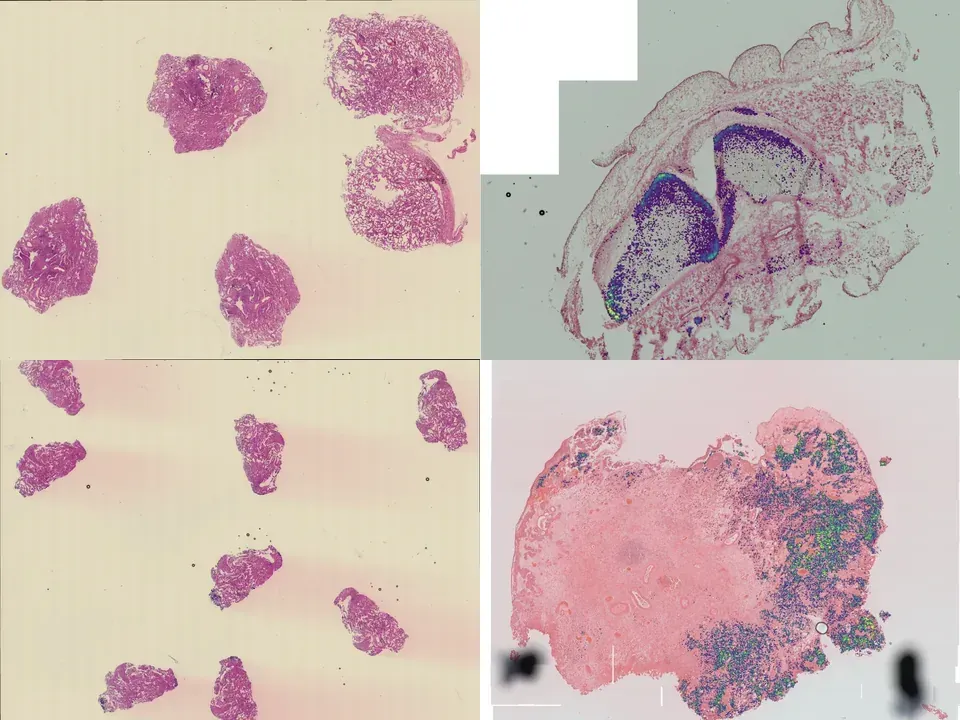
Human knee
GSM8993724
human knee 326 MB 88,814 bins silver H&E NCBI GEO policy
TechnologyVisium HD
Organismhuman
Tissueknee
Bins88,814
silver H&E NCBI GEO policy
from sddb import Catalog

cohort = Catalog().collection("geo-gse260926")
cohort.members        # the 1 datasets as a table

print(cohort.licenses())              # check the terms before you download

sdatas = cohort.to_dict()             # {uid: SpatialData}, cached locally
# or keep the .zarr files in a folder of your choice:
# sdatas = cohort.to_dict(dest="data/")Needs pip install lamindb and network access to the Lamin database, which is limited during the alpha. If it fails, use the Client tab.
import lamindb as ln

db = ln.DB("scverse/spatialdata-db")
coll = db.Collection.get(key="geo-gse260926")
coll.ordered_artifacts.to_dataframe()   # the 1 members, ordered

# download every member .zarr to the local cache:
paths = [a.cache() for a in coll.ordered_artifacts.all()]# sddb client: download every member .zarr into data/
sddb-cli download --collection geo-gse260926 --dest data/Licenses: 1 NCBI GEO policy
<h4>Objective</h4>Compromises to the integrity of articular cartilage, whether genetic, post-traumatic or age-related, lead to debilitating chronic degenerative diseases including osteoarthritis. In this study, our objective was to leverage multiomic and spatial transcriptomic datasets to identify gene regulatory networks that drive human articular cartilage cell fate, and build a foundation from which novel therapeutics to overcome degenerative disease could be developed.<h4>Design</h4>We jointly profiled the transcriptome and open chromatin regions in individual nuclei recovered from distal femora at 2 fetal timepoints and performed high-definition spatial transcriptomics at an additional timepoint. We established a human pluripotent stem cell platform to interrogate the function of computationally predicted transcription factors during human chondrocyte differentiation.<h4>Results</h4>We computationally predicted gene regulatory networks governing chondrocyte subsets comprising the human distal femur during development. Following functional analysis of two transcription factors predicted to function in the superficial zone, CREB5 and NFATC2, using our in vitro experimental platform, we found both have the potential to reprogram growth plate cartilage and induce features of articular cartilage. We further identified new biological roles for CREB5 related to ECM organization and taxis.<h4>Conclusions</h4>We expect new regulatory networks we uncovered to be important for promoting cartilage health and treating disease, and our platform to be a useful tool for studying cartilage development and homeostasis in vitro. The ability to reprogram chondrocytes toward an articular-like fate has significant therapeutic potential to treat degenerative joint diseases.
@article{Jachim_2026,
  title = {Leveraging single cell multiomic analyses to identify gene regulatory networks that drive human articular cartilage cell fate},
  volume = {34},
  ISSN = {1063-4584},
  url = {http://dx.doi.org/10.1016/j.joca.2025.12.025},
  DOI = {10.1016/j.joca.2025.12.025},
  number = {3},
  journal = {Osteoarthritis and Cartilage},
  publisher = {Elsevier BV},
  author = {Jachim, Sarah K. and Venkatasubramanian, Divya and Senevirathne, Gayani and Zhu, Andrew S. and Vitale, Concetta S. and Melendez, Delmy L. and Zhang, Cheng-Hai and Lassar, Andrew B. and Capellini, Terence D. and Craft, April M.},
  year = {2026},
  month = Mar,
  pages = {358–371}
}