Collections / A spatiotemporal molecular atlas of mouse spinal cord injury identifies a distinct astrocyte subpopulation and therapeutic potential of IGFBP2

A spatiotemporal molecular atlas of mouse spinal cord injury identifies a distinct astrocyte subpopulation and therapeutic potential of IGFBP2

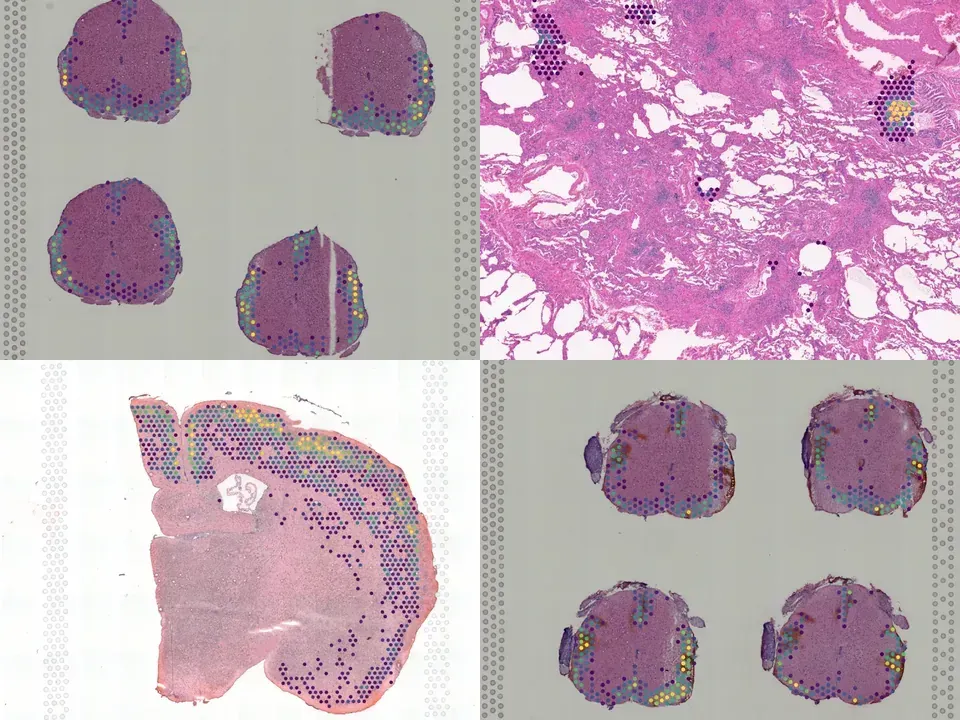
Spinal cord injury (SCI) triggers a cascade of intricate molecular and cellular changes that determine the outcome. In this study, we resolve the spatiotemporal organization of the injured mouse spinal cord and quantitatively assess in situ cell-cell communication following SCI. By analyzing existing single-cell RNA-sequencing datasets alongside our spatial data, we delineate a subpopulation of Igfbp2-expressing astrocytes that migrate from the white matter (WM) to grey matter (GM) and become reactive upon SCI, termed as Astro-GMii. Further, Igfbp2 upregulation promotes astrocyte migration, proliferation and reactivity, and the secreted IGFBP2 protein fosters neurite outgrowth. Finally, we show that IGFBP2 significantly reduces neuronal loss and remarkably improves the functional recovery in a mouse model of SCI in vivo. Together, this study not only provides a comprehensive molecular atlas of SCI but also exemplifies how the rich resource can be applied to endow cells and genes with functional insight and therapeutic potential.

Datasets16
Size~434 MB
AssayVisium
Samplemouse · spinal cord
KindComparison
Flag a data issue
PMID:39029468 ↗
Python · sddb client
from sddb import Catalog

cohort = Catalog().collection("geo-gse256397")
cohort.members        # the 16 datasets as a table

print(cohort.licenses())              # check the terms before you download

sdatas = cohort.to_dict()             # {uid: SpatialData}, cached locally
# or keep the .zarr files in a folder of your choice:
# sdatas = cohort.to_dict(dest="data/")
Python · lamindb

Needs pip install lamindb and network access to the Lamin database, which is limited during the alpha. If it fails, use the Client tab.

import lamindb as ln

db = ln.DB("scverse/spatialdata-db")
coll = db.Collection.get(key="geo-gse256397")
coll.ordered_artifacts.to_dataframe()   # the 16 members, ordered

# download every member .zarr to the local cache:
paths = [a.cache() for a in coll.ordered_artifacts.all()]
Shell
# sddb client: download every member .zarr into data/
sddb-cli download --collection geo-gse256397 --dest data/

Licenses: 16 NCBI GEO policy
Open in Vitessce
Visium
Mouse spinal cord
GSM8097058
mouse spinal cord 26.3 MB 1,440 spots bronze H&E NCBI GEO policy
TechnologyVisium
Organismmouse
Tissuespinal cord
Size26.3 MB
Spots1,440
Magnificationother · 3.318 µm/px
bronze H&E NCBI GEO policy Open in Vitessce
Open in Vitessce
Visium
Mouse spinal cord
GSM8097060
mouse spinal cord spinal cord injury 24.8 MB 1,691 spots bronze H&E NCBI GEO policy
TechnologyVisium
Organismmouse
Tissuespinal cord
Conditionspinal cord injury
Size24.8 MB
Spots1,691
Magnificationother · 3.306 µm/px
bronze H&E NCBI GEO policy Open in Vitessce
Open in Vitessce
Visium
Mouse spinal cord
GSM8097064
mouse spinal cord spinal cord injury 21.4 MB 1,401 spots bronze H&E NCBI GEO policy
TechnologyVisium
Organismmouse
Tissuespinal cord
Conditionspinal cord injury
Size21.4 MB
Spots1,401
Magnificationother · 3.288 µm/px
bronze H&E NCBI GEO policy Open in Vitessce
Open in Vitessce
Visium
Mouse spinal cord
GSM8097070
mouse spinal cord spinal cord injury 48.6 MB 4,992 spots bronze H&E NCBI GEO policy
TechnologyVisium
Organismmouse
Tissuespinal cord
Conditionspinal cord injury
Size48.6 MB
Spots4,992
Magnificationother · 3.297 µm/px
bronze H&E NCBI GEO policy Open in Vitessce
Open in Vitessce
Visium
Mouse spinal cord
GSM8097065
mouse spinal cord spinal cord injury 27.6 MB 1,500 spots bronze H&E NCBI GEO policy
TechnologyVisium
Organismmouse
Tissuespinal cord
Conditionspinal cord injury
Size27.6 MB
Spots1,500
Magnificationother · 3.309 µm/px
bronze H&E NCBI GEO policy Open in Vitessce
Open in Vitessce
Visium
Mouse spinal cord
GSM8097067
mouse spinal cord spinal cord injury 28.0 MB 1,264 spots bronze H&E NCBI GEO policy
TechnologyVisium
Organismmouse
Tissuespinal cord
Conditionspinal cord injury
Size28.0 MB
Spots1,264
Magnificationother · 3.286 µm/px
bronze H&E NCBI GEO policy Open in Vitessce
Open in Vitessce
Visium
Mouse spinal cord
GSM8097056
mouse spinal cord 26.9 MB 1,417 spots bronze H&E NCBI GEO policy
TechnologyVisium
Organismmouse
Tissuespinal cord
Size26.9 MB
Spots1,417
Magnificationother · 3.350 µm/px
bronze H&E NCBI GEO policy Open in Vitessce
Open in Vitessce
Visium
Mouse spinal cord
GSM8097066
mouse spinal cord spinal cord injury 45.9 MB 4,992 spots bronze H&E NCBI GEO policy
TechnologyVisium
Organismmouse
Tissuespinal cord
Conditionspinal cord injury
Size45.9 MB
Spots4,992
Magnificationother · 3.296 µm/px
bronze H&E NCBI GEO policy Open in Vitessce
Open in Vitessce
Visium
Mouse spinal cord
GSM8097057
mouse spinal cord 18.4 MB 1,273 spots bronze H&E NCBI GEO policy
TechnologyVisium
Organismmouse
Tissuespinal cord
Size18.4 MB
Spots1,273
Magnificationother · 3.354 µm/px
bronze H&E NCBI GEO policy Open in Vitessce
Open in Vitessce
Visium
Mouse spinal cord
GSM8097061
mouse spinal cord spinal cord injury 21.8 MB 1,558 spots bronze H&E NCBI GEO policy
TechnologyVisium
Organismmouse
Tissuespinal cord
Conditionspinal cord injury
Size21.8 MB
Spots1,558
Magnificationother · 3.297 µm/px
bronze H&E NCBI GEO policy Open in Vitessce
Open in Vitessce
Visium
Mouse spinal cord
GSM8097055
mouse spinal cord 27.5 MB 1,455 spots bronze H&E NCBI GEO policy
TechnologyVisium
Organismmouse
Tissuespinal cord
Size27.5 MB
Spots1,455
Magnificationother · 3.285 µm/px
bronze H&E NCBI GEO policy Open in Vitessce
Open in Vitessce
Visium
Mouse spinal cord
GSM8097059
mouse spinal cord spinal cord injury 26.5 MB 1,474 spots bronze H&E NCBI GEO policy
TechnologyVisium
Organismmouse
Tissuespinal cord
Conditionspinal cord injury
Size26.5 MB
Spots1,474
Magnificationother · 3.291 µm/px
bronze H&E NCBI GEO policy Open in Vitessce
Open in Vitessce
Visium
Mouse spinal cord
GSM8097063
mouse spinal cord spinal cord injury 29.4 MB 1,433 spots bronze H&E NCBI GEO policy
TechnologyVisium
Organismmouse
Tissuespinal cord
Conditionspinal cord injury
Size29.4 MB
Spots1,433
Magnificationother · 3.296 µm/px
bronze H&E NCBI GEO policy Open in Vitessce
Open in Vitessce
Visium
Mouse spinal cord
GSM8097068
mouse spinal cord spinal cord injury 20.2 MB 1,080 spots bronze H&E NCBI GEO policy
TechnologyVisium
Organismmouse
Tissuespinal cord
Conditionspinal cord injury
Size20.2 MB
Spots1,080
Magnificationother · 3.299 µm/px
bronze H&E NCBI GEO policy Open in Vitessce
Open in Vitessce
Visium
Mouse spinal cord
GSM8097069
mouse spinal cord spinal cord injury 16.2 MB 1,304 spots bronze H&E NCBI GEO policy
TechnologyVisium
Organismmouse
Tissuespinal cord
Conditionspinal cord injury
Size16.2 MB
Spots1,304
bronze H&E NCBI GEO policy Open in Vitessce
Open in Vitessce
Visium
Mouse spinal cord
GSM8097062
mouse spinal cord spinal cord injury 24.1 MB 1,488 spots bronze H&E NCBI GEO policy
TechnologyVisium
Organismmouse
Tissuespinal cord
Conditionspinal cord injury
Size24.1 MB
Spots1,488
Magnificationother · 3.336 µm/px
bronze H&E NCBI GEO policy Open in Vitessce

Cite this collection

doi.org/10.1016/j.devcel.2024.06.016 ↗
BibTeX
@article{Wang_2024,
  title = {A spatiotemporal molecular atlas of mouse spinal cord injury identifies a distinct astrocyte subpopulation and therapeutic potential of IGFBP2},
  volume = {59},
  ISSN = {1534-5807},
  url = {http://dx.doi.org/10.1016/j.devcel.2024.06.016},
  DOI = {10.1016/j.devcel.2024.06.016},
  number = {20},
  journal = {Developmental Cell},
  publisher = {Elsevier BV},
  author = {Wang, Zeqing and Li, Zhuxia and Luan, Tianle and Cui, Guizhong and Shu, Shunpan and Liang, Yiyao and Zhang, Kai and Xiao, Jingshu and Yu, Wei and Cui, Jihong and Li, Ang and Peng, Guangdun and Fang, Yanshan},
  year = {2024},
  month = Oct,
  pages = {2787–2803.e8}
}