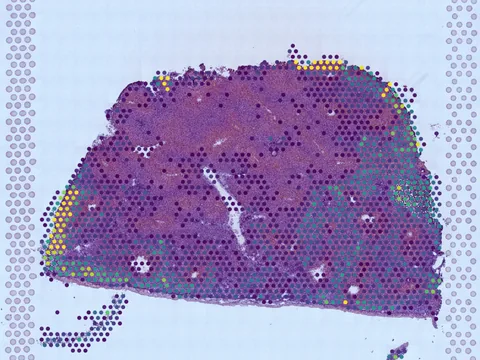
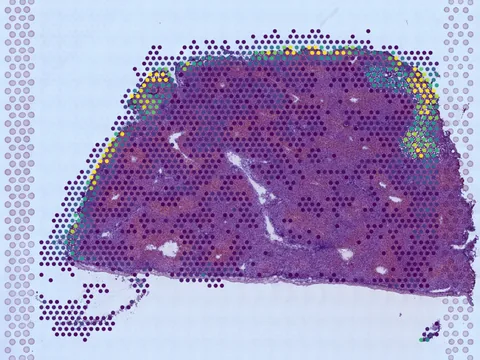
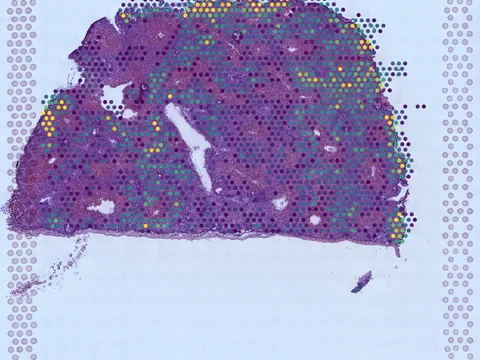
from sddb import Catalog

cohort = Catalog().collection("geo-gse243981")
cohort.members        # the 3 datasets as a table

print(cohort.licenses())              # check the terms before you download

sdatas = cohort.to_dict()             # {uid: SpatialData}, cached locally
# or keep the .zarr files in a folder of your choice:
# sdatas = cohort.to_dict(dest="data/")
Needs pip install lamindb and network access to the Lamin database, which is limited during the alpha. If it fails, use the Client tab.
import lamindb as ln

db = ln.DB("scverse/spatialdata-db")
coll = db.Collection.get(key="geo-gse243981")
coll.ordered_artifacts.to_dataframe()   # the 3 members, ordered

# download every member .zarr to the local cache:
paths = [a.cache() for a in coll.ordered_artifacts.all()]
Single-cell, single-nucleus, and spatial transcriptomics characterization of the immunological landscape in the healthy and PSC human liver.
<h4>Background & aims</h4>Primary sclerosing cholangitis (PSC) is an immune-mediated cholestatic liver disease for which there is an unmet need to understand the cellular composition of the affected liver and how it underlies disease pathogenesis. We aimed to generate a comprehensive atlas of the PSC liver using multi-omic modalities and protein-based functional validation.<h4>Methods</h4>We employed single-cell and single-nucleus RNA sequencing (47,156 cells and 23,000 nuclei) and spatial transcriptomics (one sample by 10x Visium and five samples with Nanostring GeoMx DSP) to profile the cellular ecosystem in 10 PSC livers. Transcriptomic profiles were compared to 24 neurologically deceased donor livers (107,542 cells) and spatial transcriptomics controls, as well as 18,240 cells and 20,202 nuclei from three PBC livers. Flow cytometry was performed to validate PSC-specific differences in immune cell phenotype and function.<h4>Results</h4>PSC explants with parenchymal cirrhosis and prominent periductal fibrosis contained a population of cholangiocyte-like hepatocytes that were surrounded by diverse immune cell populations. PSC-associated biliary, mesenchymal, and endothelial populations expressed chemokine and cytokine transcripts involved in immune cell recruitment. Additionally, expanded CD4<sup>+</sup> T cells and recruited myeloid populations in the PSC liver expressed the corresponding receptors to these chemokines and cytokines, suggesting potential recruitment. Tissue-resident macrophages, by contrast, were reduced in number and exhibited a dysfunctional and downregulated inflammatory response to lipopolysaccharide and interferon-γ stimulation.<h4>Conclusions</h4>We present a comprehensive atlas of the PSC liver and demonstrate an exhaustion-like phenotype of myeloid cells and markers of chronic cytokine expression in late-stage PSC lesions. This atlas expands our understanding of the cellular complexity of PSC and has potential to guide the development of novel treatments.<h4>Impact and implications</h4>Primary sclerosing cholangitis (PSC) is a rare liver disease characterized by chronic inflammation and irreparable damage to the bile ducts, which eventually results in liver failure. Due to a limited understanding of the underlying pathogenesis of disease, treatment options are limited. To address this, we sequenced healthy and diseased livers to compare the activity, interactions, and localization of immune and non-immune cells. This revealed that hepatocytes lining PSC scar regions co-express cholangiocyte markers, whereas immune cells infiltrate the scar lesions. Of these cells, macrophages, which typically contribute to tissue repair, were enriched in immunoregulatory genes and demonstrated a lack of responsiveness to stimulation. These cells may be involved in maintaining hepatic inflammation and could be a target for novel therapies.
Member datasets · 3
Visium
Human liver
Single-cell and spatial transcriptomics characterisation of the immunological landscape in the healthy and PSC human liver [GSM7697868]
@article{Andrews_2024,
  title = {Single-cell, single-nucleus, and spatial transcriptomics characterization of the immunological landscape in the healthy and PSC human liver},
  volume = {80},
  ISSN = {0168-8278},
  url = {http://dx.doi.org/10.1016/j.jhep.2023.12.023},
  DOI = {10.1016/j.jhep.2023.12.023},
  number = {5},
  journal = {Journal of Hepatology},
  publisher = {Elsevier BV},
  author = {Andrews, Tallulah S. and Nakib, Diana and Perciani, Catia T. and Ma, Xue Zhong and Liu, Lewis and Winter, Erin and Camat, Damra and Chung, Sai W. and Lumanto, Patricia and Manuel, Justin and Mangroo, Shantel and Hansen, Bettina and Arpinder, Bal and Thoeni, Cornelia and Sayed, Blayne and Feld, Jordan and Gehring, Adam and Gulamhusein, Aliya and Hirschfield, Gideon M. and Ricciuto, Amanda and Bader, Gary D. and McGilvray, Ian D. and MacParland, Sonya},
  year = {2024},
  month = May,
  pages = {730–743}
}