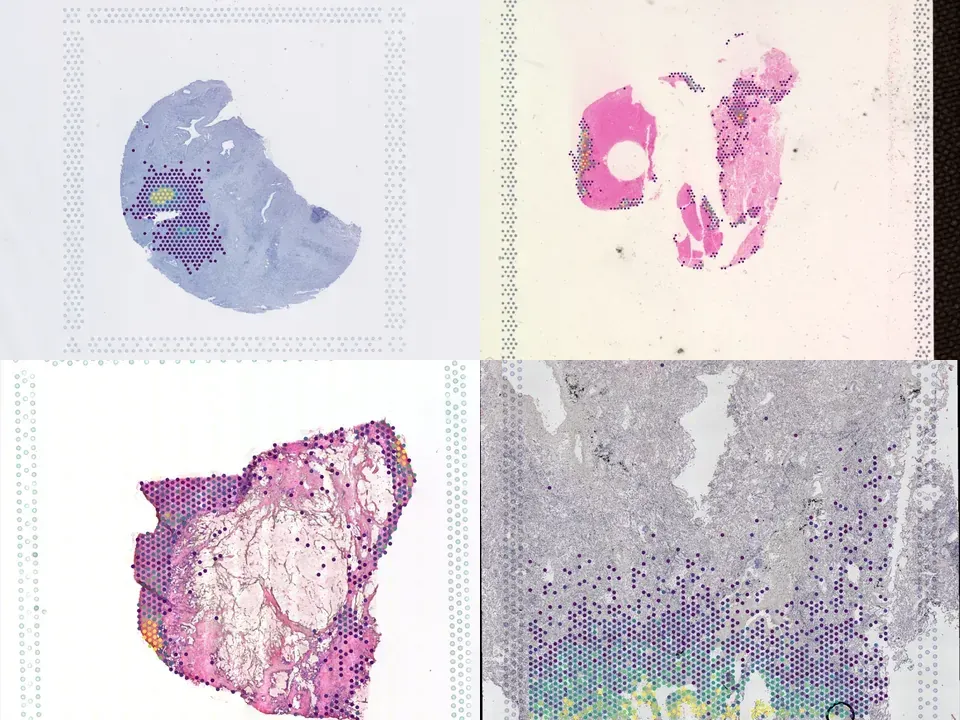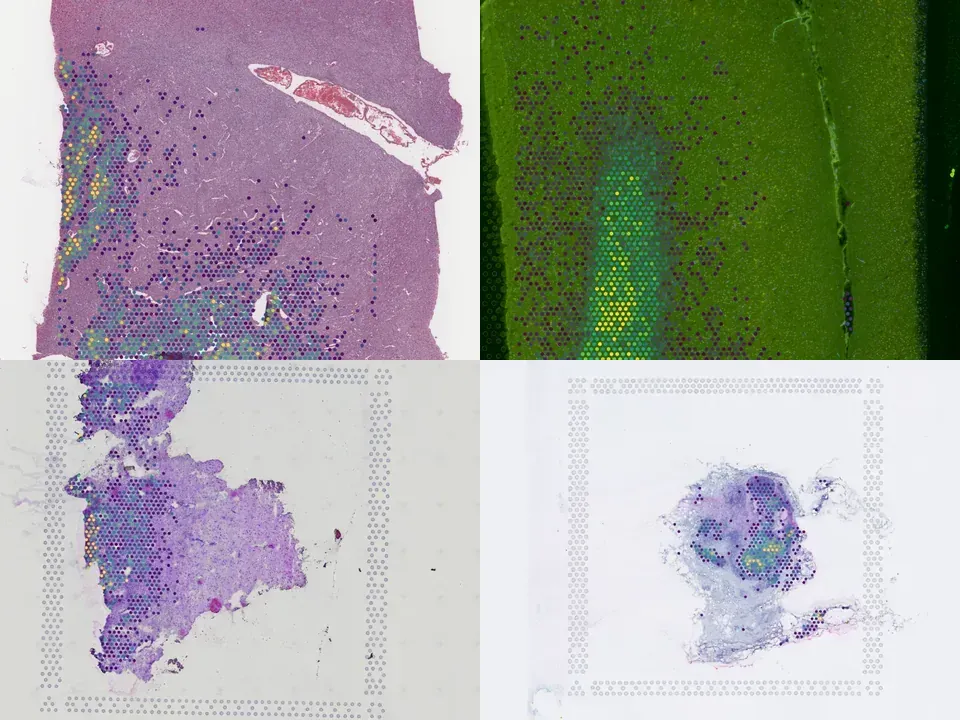
Collections / Uncovering the spatial landscape of molecular interactions within the tumor microenvironment through latent spaces

Uncovering the spatial landscape of molecular interactions within the tumor microenvironment through latent spaces

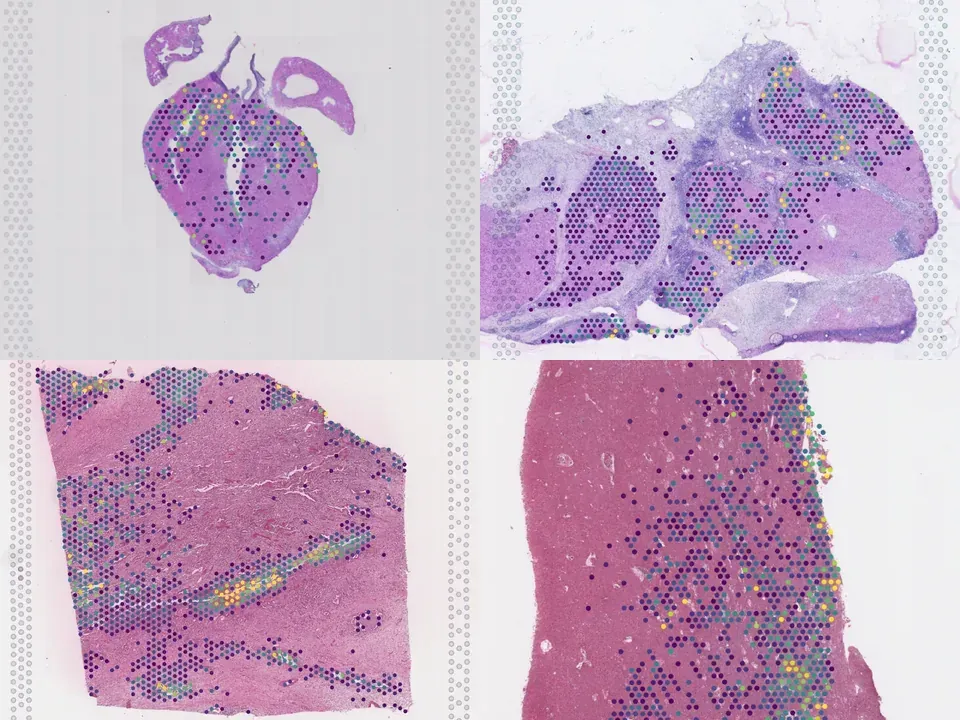
Recent advances in spatial transcriptomics (ST) enable gene expression measurements from a tissue sample while retaining its spatial context. This technology enables unprecedented in situ resolution of the regulatory pathways that underlie the heterogeneity in the tumor and its microenvironment (TME). The direct characterization of cellular co-localization with spatial technologies facilities quantification of the molecular changes resulting from direct cell-cell interaction, as occurs in tumor-immune interactions. We present SpaceMarkers, a novel bioinformatics algorithm to infer molecular changes from cell-cell interaction from latent space analysis of ST data. We apply this approach to infer molecular changes from tumor-immune interactions in Visium spatial transcriptomics data of metastasis, invasive and precursor lesions, and immunotherapy treatment. Further transfer learning in matched scRNA-seq data enabled further quantification of the specific cell types in which SpaceMarkers are enriched. Altogether, SpaceMarkers can identify the location and context-specific molecular interactions within the TME from ST data.

Datasets3
Size~62.0 MB
AssayVisium
Samplehuman · multiple
KindComparison
Flag a data issue
PMID:37080163 ↗
Python · sddb client
from sddb import Catalog

cohort = Catalog().collection("geo-gse224411")
cohort.members        # the 3 datasets as a table

print(cohort.licenses())              # check the terms before you download

sdatas = cohort.to_dict()             # {uid: SpatialData}, cached locally
# or keep the .zarr files in a folder of your choice:
# sdatas = cohort.to_dict(dest="data/")
Python · lamindb

Needs pip install lamindb and network access to the Lamin database, which is limited during the alpha. If it fails, use the Client tab.

import lamindb as ln

db = ln.DB("scverse/spatialdata-db")
coll = db.Collection.get(key="geo-gse224411")
coll.ordered_artifacts.to_dataframe()   # the 3 members, ordered

# download every member .zarr to the local cache:
paths = [a.cache() for a in coll.ordered_artifacts.all()]
Shell
# sddb client: download every member .zarr into data/
sddb-cli download --collection geo-gse224411 --dest data/

Licenses: 3 NCBI GEO policy

Open in Vitessce
Visium
Human lymph node
GSM7021872
human lymph node pancreatic ductal adenocarcinoma 7.5 MB 1,351 spots silver H&E NCBI GEO policy
TechnologyVisium
Organismhuman
Tissuelymph node
Conditionpancreatic ductal adenocarcinoma
Size7.5 MB
Spots1,351
silver H&E NCBI GEO policy Open in Vitessce
Open in Vitessce
Visium
Human pancreas
GSM7021871
human pancreas pancreatic ductal adenocarcinoma 30.6 MB 1,872 spots silver H&E NCBI GEO policy
TechnologyVisium
Organismhuman
Tissuepancreas
Conditionpancreatic ductal adenocarcinoma
Size30.6 MB
Spots1,872
silver H&E NCBI GEO policy Open in Vitessce
Open in Vitessce
Visium
Human liver
GSM7021870
human liver hepatocellular carcinoma 23.9 MB 3,006 spots silver H&E NCBI GEO policy
TechnologyVisium
Organismhuman
Tissueliver
Conditionhepatocellular carcinoma
Size23.9 MB
Spots3,006
silver H&E NCBI GEO policy Open in Vitessce

Cite this collection

No linked publication found — please cite the data source.