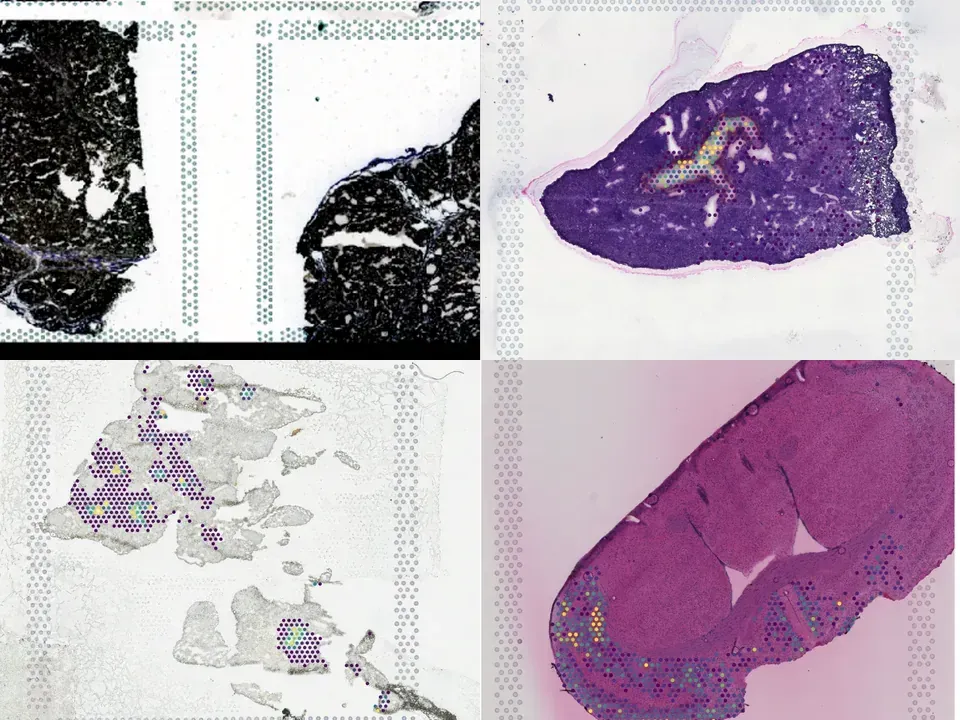
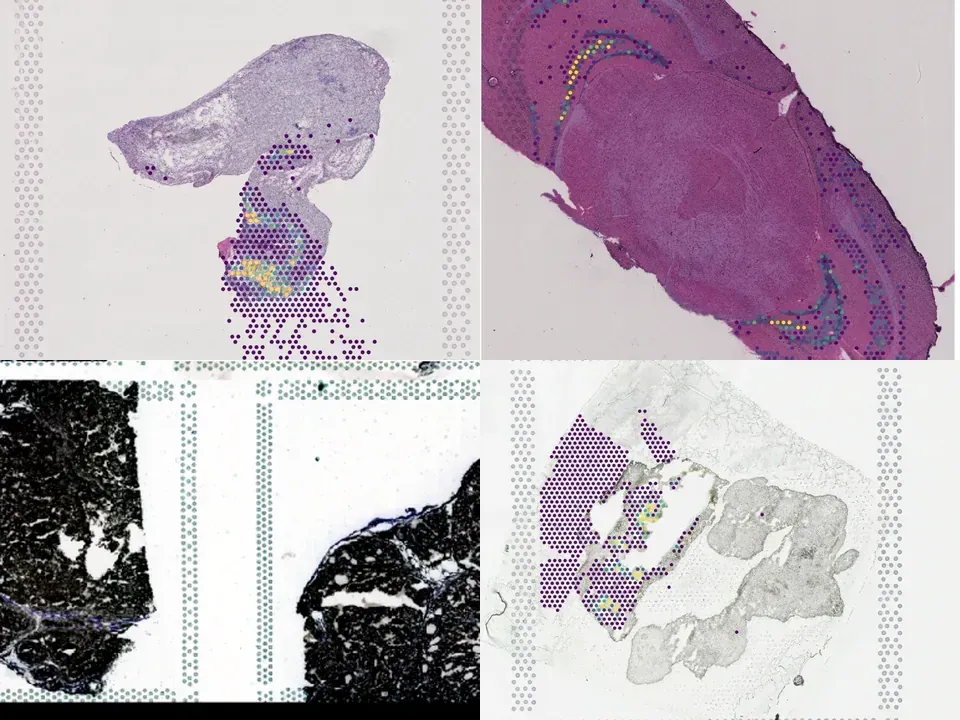
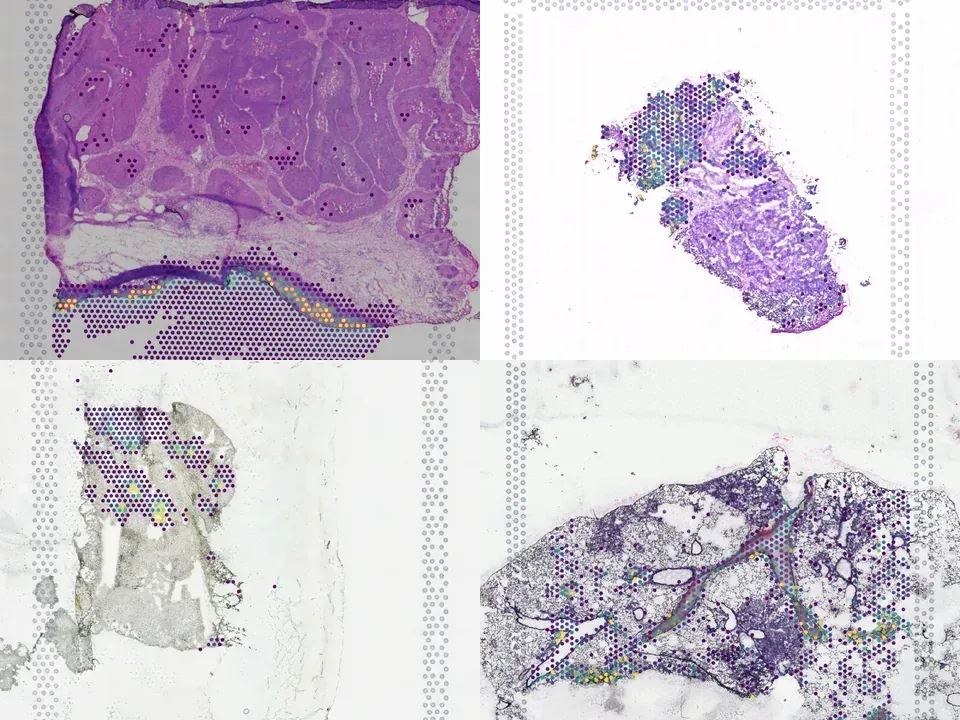
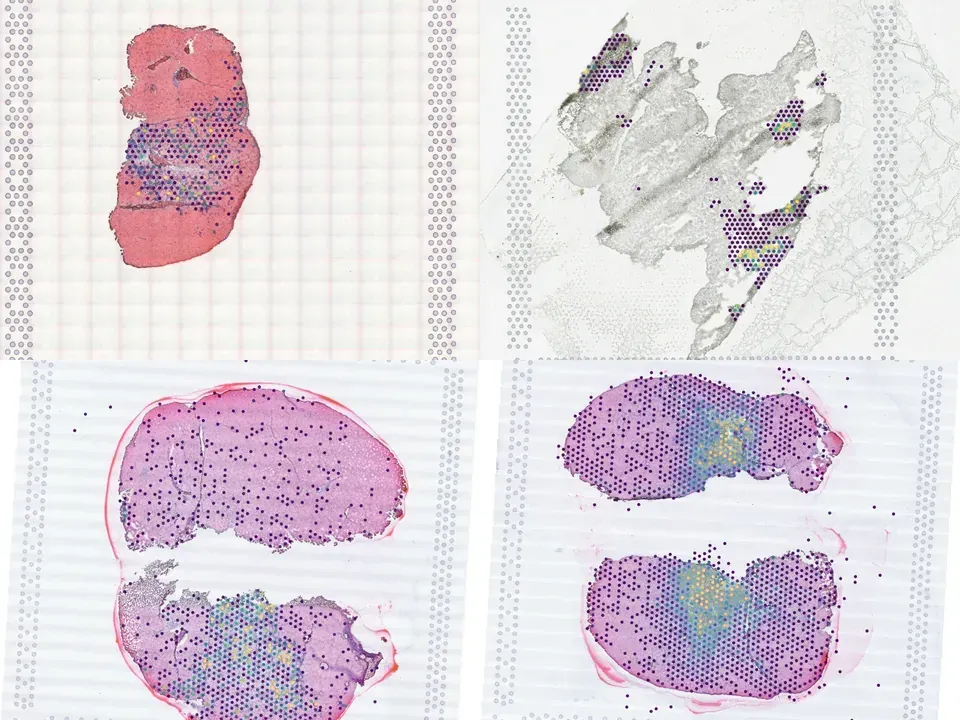
Collections / Perturb-map coupled with spatial transcriptomics identifies mutation associated gene signatures in a mouse model of lung adenocarcinoma
Perturb-map coupled with spatial transcriptomics identifies mutation associated gene signatures in a mouse model of lung adenocarcinoma
The cellular architecture of a tumor has a major impact on cancer outcome, and thus there is interest in identifying genes controlling the tumor microenvironment (TME). While CRISPR screens are helping uncover genes regulating many cell-intrinsic processes, existing approaches are suboptimal for identifying gene functions operating extracellularly or within a tissue context. To address this, we developed an approach for spatial functional genomics called Perturb-map, which utilizes protein barcodes (Pro-Code) to enable spatial detection of barcoded cells within tissue. We applied Perturb-map to knockout dozens of genes in parallel in a mouse model of lung cancer and simultaneously assessed how each knockout influenced tumor growth, histopathology, and immune composition. Additionally, we paired Perturb-map and spatial transcriptomics for unbiased molecular analysis of Pro-Code/CRISPR lesions. Our studies found in Tgfbr2 knockout lesions, the TME was converted to a fibro-mucinous state and T-cells excluded, concomitant with upregulated TGFb and TGFb-mediated stroma activation, suggesting Tgfbr2 loss on lung cancer cells increased TGFb bioavailability and enhanced its suppressive effects on the TME. These studies establish Perturb-map for functional genomics within a tissue at single cell-resolution with spatial architecture preserved.
from sddb import Catalog

cohort = Catalog().collection("geo-gse193460")
cohort.members        # the 4 datasets as a table

print(cohort.licenses())              # check the terms before you download

sdatas = cohort.to_dict()             # {uid: SpatialData}, cached locally
# or keep the .zarr files in a folder of your choice:
# sdatas = cohort.to_dict(dest="data/")
Needs pip install lamindb and network access to the Lamin database, which is limited during the alpha. If it fails, use the Client tab.
import lamindb as ln

db = ln.DB("scverse/spatialdata-db")
coll = db.Collection.get(key="geo-gse193460")
coll.ordered_artifacts.to_dataframe()   # the 4 members, ordered

# download every member .zarr to the local cache:
paths = [a.cache() for a in coll.ordered_artifacts.all()]
@article{Dhainaut_2022,
  title = {Spatial CRISPR genomics identifies regulators of the tumor microenvironment},
  volume = {185},
  ISSN = {0092-8674},
  url = {http://dx.doi.org/10.1016/j.cell.2022.02.015},
  DOI = {10.1016/j.cell.2022.02.015},
  number = {7},
  journal = {Cell},
  publisher = {Elsevier BV},
  author = {Dhainaut, Maxime and Rose, Samuel A. and Akturk, Guray and Wroblewska, Aleksandra and Nielsen, Sebastian R. and Park, Eun Sook and Buckup, Mark and Roudko, Vladimir and Pia, Luisanna and Sweeney, Robert and Le Berichel, Jessica and Wilk, C. Matthias and Bektesevic, Anela and Lee, Brian H. and Bhardwaj, Nina and Rahman, Adeeb H. and Baccarini, Alessia and Gnjatic, Sacha and Pe’er, Dana and Merad, Miriam and Brown, Brian D.},
  year = {2022},
  month = Mar,
  pages = {1223–1239.e20}
}