
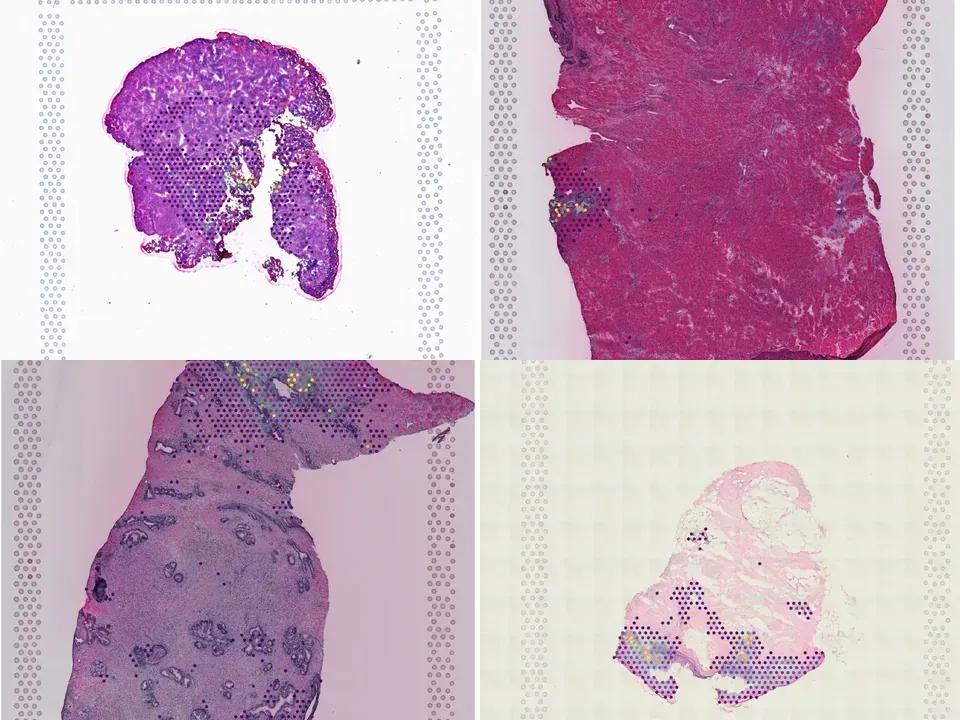
Human uterine cervix
NCBI1
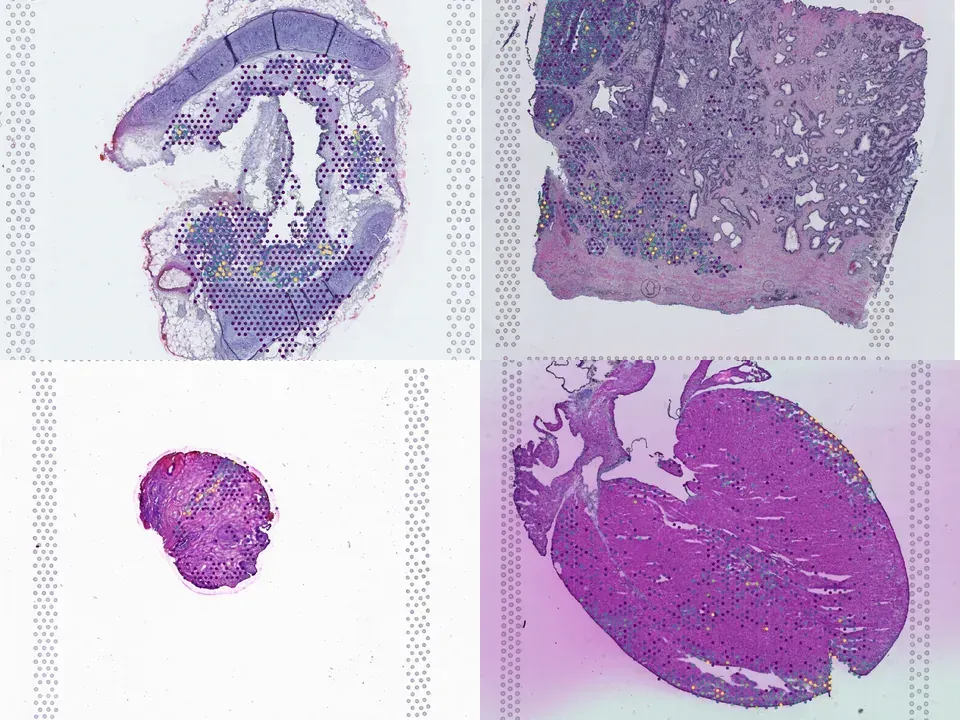
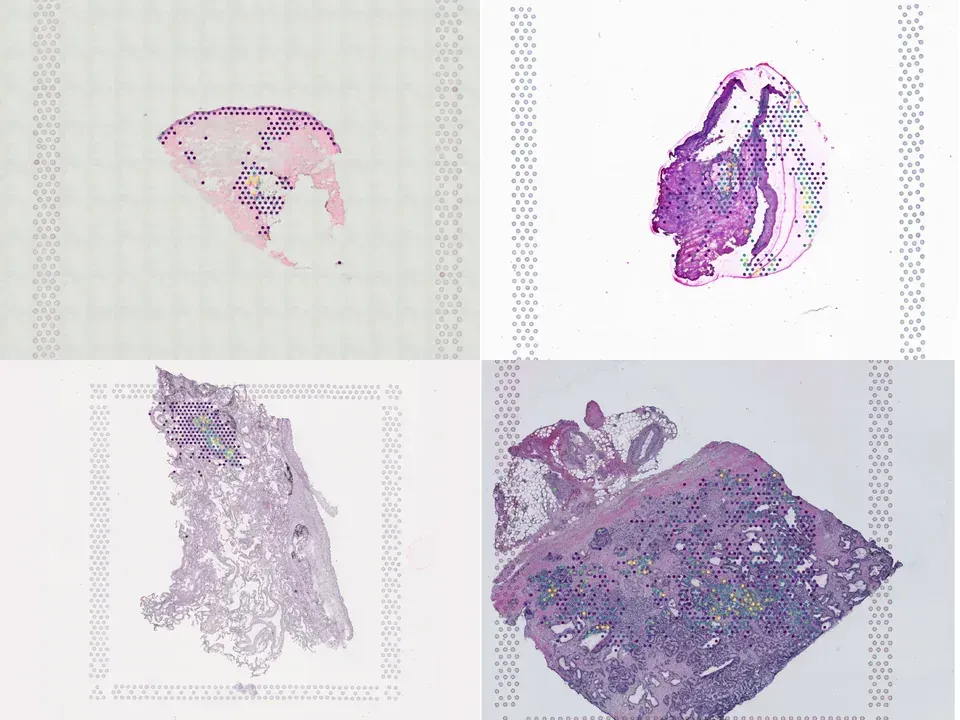
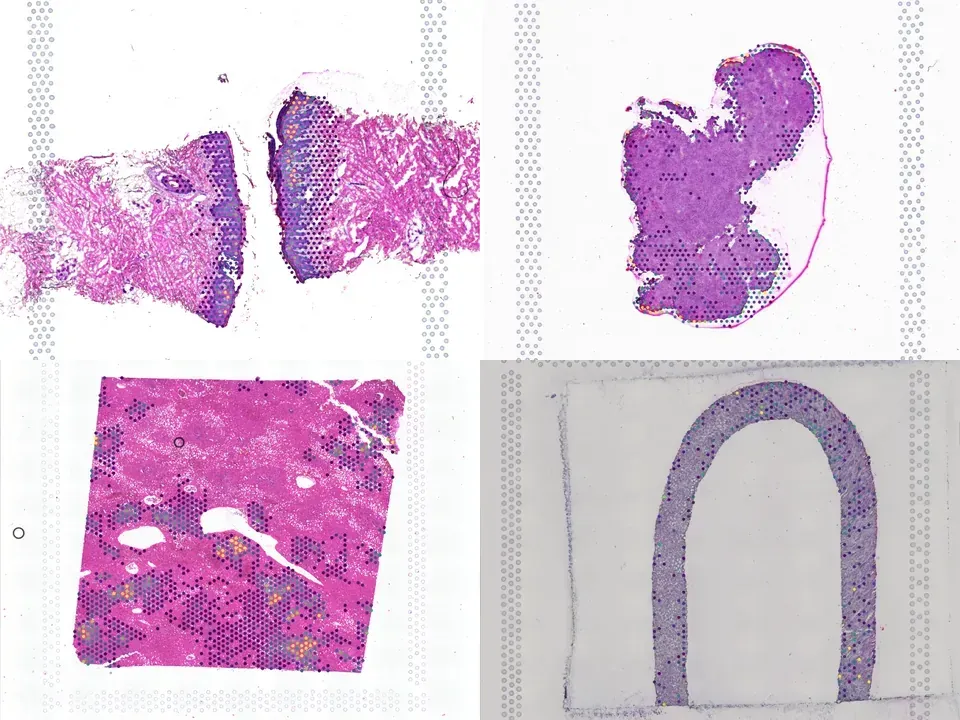
human uterine cervix cervical carcinoma 175 MB 1,593 spots silver H&E
TechnologyVisium
Organismhuman
Tissueuterine cervix
Conditioncervical carcinoma
Spots1,593
silver H&E
from sddb import Catalog

cohort = Catalog().collection("doi-10-1002-ctm2-1219")
cohort.members        # the 4 datasets as a table

print(cohort.licenses())              # check the terms before you download

sdatas = cohort.to_dict()             # {uid: SpatialData}, cached locally
# or keep the .zarr files in a folder of your choice:
# sdatas = cohort.to_dict(dest="data/")Needs pip install lamindb and network access to the Lamin database, which is limited during the alpha. If it fails, use the Client tab.
import lamindb as ln

db = ln.DB("scverse/spatialdata-db")
coll = db.Collection.get(key="doi-10.1002/ctm2.1219")
coll.ordered_artifacts.to_dataframe()   # the 4 members, ordered

# download every member .zarr to the local cache:
paths = [a.cache() for a in coll.ordered_artifacts.all()]# sddb client: download every member .zarr into data/
sddb-cli download --collection doi-10-1002-ctm2-1219 --dest data/Licenses: 4 CC BY-NC-SA 4.0
<h4>Background</h4>The mechanism underlying cervical carcinogenesis that is mediated by persistent human papillomavirus (HPV) infection remains elusive.<h4>Aims</h4>Here, for the first time, we deciphered both the temporal transition and spatial distribution of cellular subsets during disease progression from normal cervix tissues to precursor lesions to cervical cancer.<h4>Materials & methods</h4>We generated scRNA-seq profiles and spatial transcriptomics data from nine patient samples, including two HPV-negative normal, two HPV-positive normal, two HPV-positive HSIL and three HPV-positive cancer samples.<h4>Results</h4>We not only identified three 'HPV-related epithelial clusters' that are unique to normal, high-grade squamous intraepithelial lesions (HSIL) and cervical cancer tissues but also discovered node genes that potentially regulate disease progression. Moreover, we observed the gradual transition of multiple immune cells that exhibited positive immune responses, followed by dysregulation and exhaustion, and ultimately established an immune-suppressive microenvironment during the malignant program. In addition, analysis of cellular interactions further verified that a 'homeostasis-balance-malignancy' change occurred within the cervical microenvironment during disease progression.<h4>Discussion</h4>We for the first time presented a spatiotemporal atlas that systematically described the cellular heterogeneity and spatial map along the four developmental steps of HPV-related cervical oncogenesis, including normal, HPV-positive normal, HSIL and cancer. We identified three unique HPV-related clusters, discovered critical node genes that determined the cell fate and uncovered the immune remodeling during disease escalation.<h4>Conclusion</h4>Together, these findings provided novel possibilities for accurate diagnosis, precise treatment and prognosis evaluation of patients with precancer and cervical cancer.
@article{Guo_2023,
  title = {Spatiotemporally deciphering the mysterious mechanism of persistent HPV‐induced malignant transition and immune remodelling from HPV‐infected normal cervix, precancer to cervical cancer: Integrating single‐cell RNA‐sequencing and spatial transcriptome},
  volume = {13},
  ISSN = {2001-1326},
  url = {http://dx.doi.org/10.1002/ctm2.1219},
  DOI = {10.1002/ctm2.1219},
  number = {3},
  journal = {Clinical and Translational Medicine},
  publisher = {Wiley},
  author = {Guo, Chenyan and Qu, Xinyu and Tang, Xiaoyan and Song, Yu and Wang, Jue and Hua, Keqin and Qiu, Junjun},
  year = {2023},
  month = Mar
}